
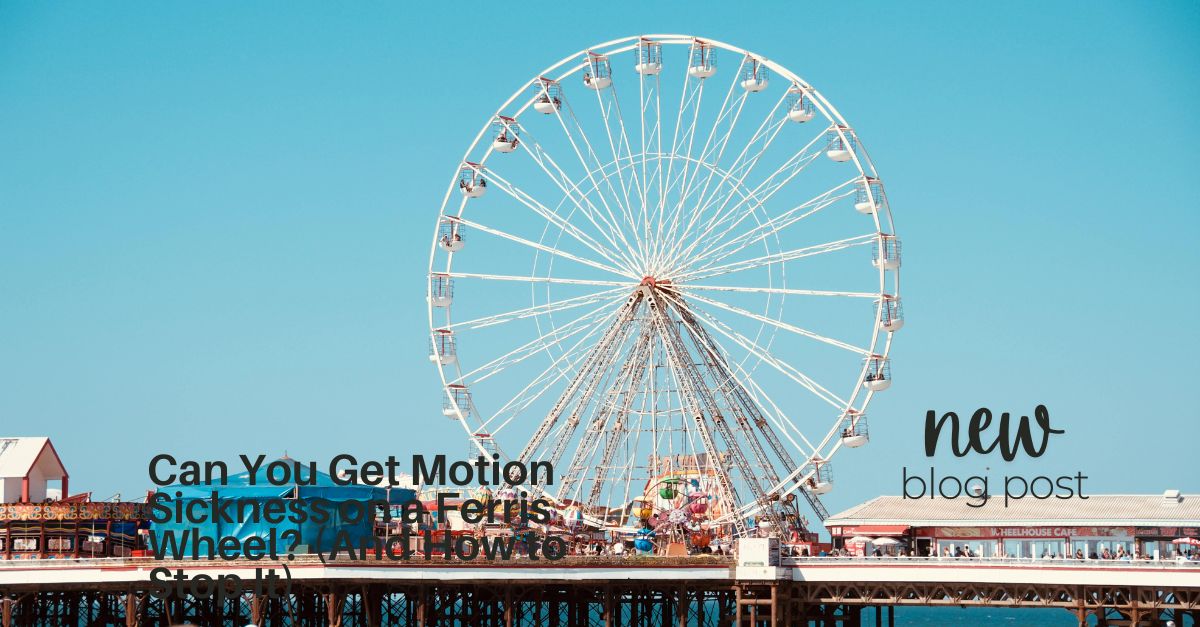
Ferris wheels are often billed as the gentle, romantic, and relaxing alternative to high-speed rollercoasters. You step into the carriage expecting breathtaking views and a peaceful ascent. But as the wheel slowly makes its way to the top, your stomach drops, a cold sweat kicks in, and the scenery suddenly starts to spin.
It is a frustrating and surprisingly common experience. If you find yourself wondering, “Can you actually get motion sickness on a ride this slow?” the answer is absolutely yes.
While they lack the massive G-forces and sudden drops of a thrill ride, Ferris wheels present their own unique set of triggers for your nervous system. Here is a simple breakdown of why that slow rotation makes you dizzy, and the best natural ways to keep your stomach settled so you can actually enjoy the view.
Why Ferris Wheels Trigger Motion Sickness
Motion sickness is never about speed; it is always about a sensory mismatch. Your brain relies on your eyes, your inner ear (vestibular system), and your physical muscles to understand where your body is in space. When those systems send conflicting reports, your brain gets confused and triggers a nausea response.
Here is exactly how a Ferris wheel creates that confusion:
1. The Continuous Circular Motion
Even though the wheel moves slowly, your inner ear is highly sensitive to continuous, repetitive circular movement. Your vestibular system feels the steady curving rotation, but if you are sitting still and staring at the person across from you in the carriage, your eyes are telling your brain that you are completely stationary.
2. The Pendulum Effect
Many Ferris wheel carriages (especially older or open-air models) swing back and forth on a hinge as the wheel turns. This creates a secondary, unpredictable rocking motion. Your brain struggles to process the forward rotation of the wheel combined with the side-to-side swaying of the carriage.
3. Visual Overload and Height
When you reach the top of the wheel and look straight down at the ground, your eyes struggle to process the extreme depth and slow shifting of the landscape. Combined with the natural adrenaline or anxiety of being high in the air, your nervous system easily tips over into dizziness and vertigo.
How to Stop the Spin: In-Carriage Strategies
If you start feeling green halfway up, you can’t exactly ask the operator to pull over. Try these immediate physical adjustments to realign your senses:
-
Lock Eyes on the Horizon: Do not look straight down at the ground, and do not stare at the floor of the carriage. Look straight out at the furthest, most stable point on the horizon. This gives your visual system a fixed anchor, helping it match the movement your inner ear is feeling.
-
Sit in the Middle: If you are in a carriage that rocks, sit as close to the center as possible to minimize the pendulum effect. Keep your head relatively still.
-
Breathe Deeply: Anxiety makes nausea worse. Practice slow, deep breathing to lower your heart rate and keep oxygen flowing.
The Ultimate Preventative Fix: The Pisix Band
Taking an over-the-counter motion sickness pill for a 15-minute Ferris wheel ride is massive overkill. Pills like Dramamine take up to an hour to kick in and leave you feeling heavily drowsy and fatigued for the rest of your day at the carnival or pier.
For fast, natural, and completely non-drowsy relief, strap on a Pisix Band before you buy your tickets.
This comfortable, drug-free wristband uses the proven science of acupressure to intercept nausea signals. It features a strategically placed stud that applies gentle, continuous pressure to the Nei-Kuan (P6) acupressure point located on your inner forearm.
Stimulating this specific nerve pathway actively blocks the “dizzy” signals traveling from your confused brain to your stomach.
Why It’s Perfect for Slow Rides:
-
Zero Drowsiness: Because it is 100% chemical-free, you won’t ruin your afternoon with brain fog or exhaustion.
-
Fast Acting: You can slip the bands on while waiting in line, or put them on the exact moment the carriage starts to sway for immediate relief.
-
Family Friendly: The soft cotton and universal stretch fit make it perfectly safe and comfortable for children who might be experiencing their first bout of ride-induced nausea.


