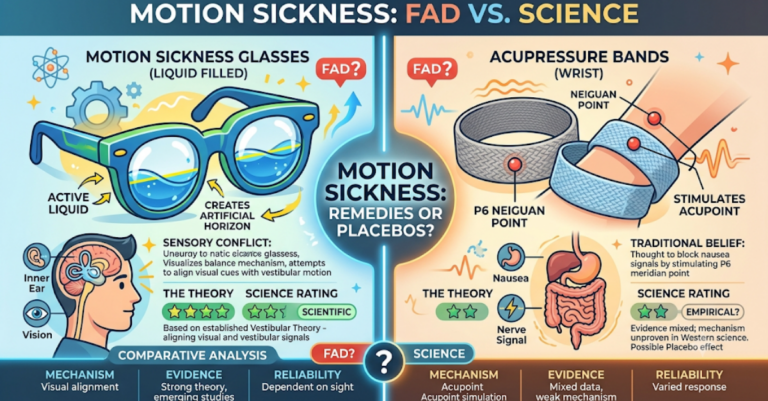
For thousands of years, traditional Eastern medicine has utilized the body’s own nervous system to treat physical ailments. Today, modern Western science has thoroughly validated two of these ancient practices—acupuncture and acupressure—as highly effective treatments for severe nausea and motion sickness.
If you are trying to avoid the heavy drowsiness and brain fog of chemical antihistamine pills (like Dramamine), both of these drug-free techniques offer incredible relief. They both target the exact same neurological pathways, but they do so in very different ways.
If you are dealing with chronic travel sickness, morning sickness, or digital cybersickness, which method is actually better? Here is the biological breakdown of needles versus pressure, and which one you should trust to settle your stomach.
The Shared Target: The Nei-Kuan (P6) Point
Before comparing the two methods, it is crucial to understand why they work. Both acupuncture and acupressure for nausea target a very specific location: the Nei-Kuan (P6) point.
Located exactly three finger-widths below the crease of your inner wrist, this point sits directly over the median nerve. This major nerve acts as a biological superhighway connecting your hand and forearm directly to your central nervous system.
When you experience a sensory mismatch (like reading in a moving car), your brain panics and sends a distress signal to your stomach, causing it to spasm. Stimulating the median nerve intercepts that panic. It sends a grounding, rhythmic signal up to the brainstem that effectively blocks the nausea signal before it can reach your digestive tract.
Both techniques stimulate this nerve, but the delivery mechanisms create vastly different experiences.
Acupuncture: The Micro-Trauma Approach
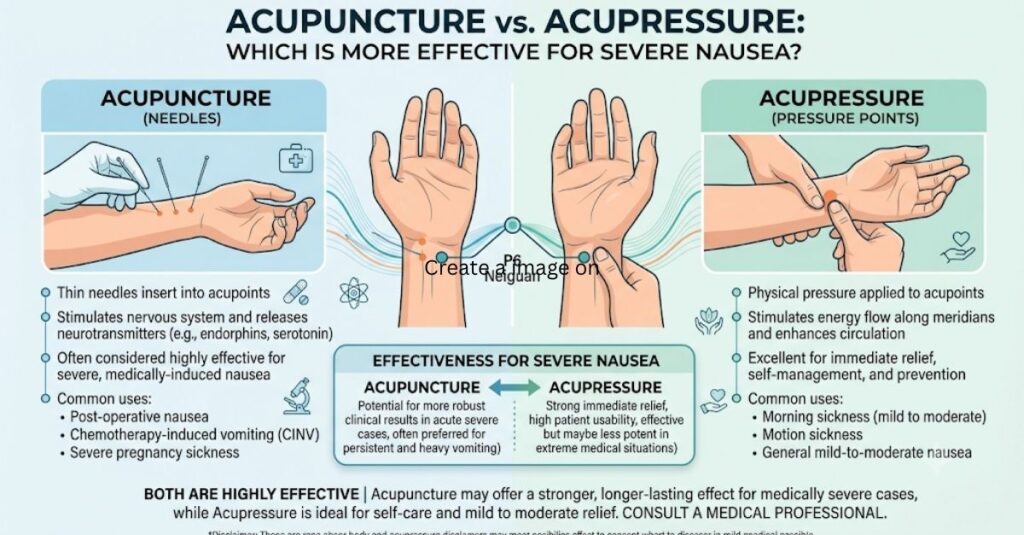
Acupuncture involves a licensed practitioner inserting hair-thin, sterile needles directly into the skin at the P6 point.
How it Works
The needle creates a controlled “micro-trauma” in the tissue right above the median nerve. This signals the central nervous system to release a rush of endorphins (the body’s natural painkillers) and increases blood flow to the area. The deep, precise stimulation of the nerve provides powerful, long-lasting relief.
The Verdict on Acupuncture
-
Pros: It is incredibly effective for systemic, chronic nausea, such as post-operative nausea or severe chemotherapy-induced stomach distress.
-
Cons: It is entirely stationary. You cannot get acupuncture while sitting in the passenger seat of a swerving car or on a turbulent flight. It requires booking an appointment, paying clinical fees, and lying perfectly still.
Acupressure: The Continuous Gate Control
Acupressure utilizes the exact same P6 median nerve, but completely eliminates the needles. Instead, it relies on steady, localized physical pressure applied to the surface of the skin.
How it Works
Acupressure relies on the neurological concept of Gate Control Theory. When continuous physical pressure is applied to the median nerve, that “touch” sensation floods the neural pathway. Because the brain prioritizes immediate physical touch over the chaotic, confusing signals coming from your inner ear during a bumpy ride, the pressure essentially “closes the gate” on the nausea signals.
The Verdict on Acupressure
-
Pros: It is 100% mobile, non-invasive, and immediate. You can apply the pressure the exact second you start feeling dizzy, whether you are on a boat, a train, or walking on a treadmill desk.
-
Cons: For the relief to work, the pressure must be highly precise and continuous. Pressing your own thumb against your wrist works temporarily, but your hand will quickly cramp up during a long journey.
The Winner for Travel & Everyday Nausea
If you are battling motion sickness, cybersickness, or morning sickness, acupressure is the clear winner. Nausea triggered by movement requires on-demand, mobile relief that travels with you.
However, to get the continuous, hands-free pressure required to keep the median nerve stimulated, you need the right tool.
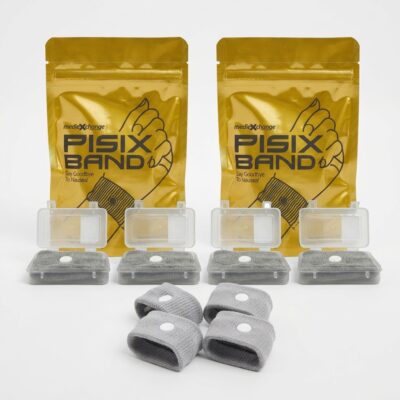
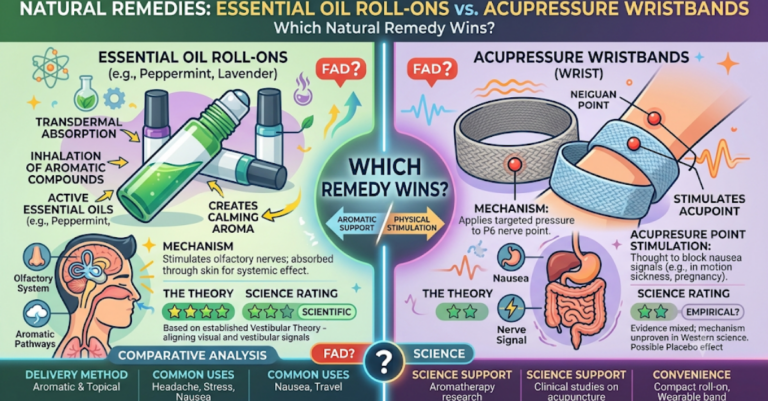
By wearing a Pisix Band, you can lock in that precise acupressure relief for your entire journey. Engineered by Mediexchange, the Pisix Band is a comfortable, stretch-fit cotton wristband equipped with a built-in precision stud. This stud is designed to apply the exact amount of continuous pressure needed to stimulate the P6 point and block the nausea signals.
Why the Pisix Band Outperforms the Clinic:
-
Clear-Headed & Drug-Free: You get powerful nerve stimulation without the heavy sedation of pills or the immobility of acupuncture needles.
-
Zero Prescription Required: Because it is a non-sterile wellness product (and does not require Class A medical device registration), it is completely accessible for everyday consumers.
-
Optimized for Immediate Logistics: Modern nausea relief needs to be ready when you are. Packaged efficiently in a compact 16.5x10x2 cm box, the bands are built for rapid quick-commerce. Whether you are ordering nationally via Amazon FBA or grabbing a pair locally through 10-minute delivery apps like Blinkit right here in Indore, you can secure true, scientifically backed relief the moment you need it.