Most people associate concussions with headaches, memory fog, and a temporary need to rest in a dark room. But long after the initial impact has healed, many concussion survivors discover a frustrating, lingering symptom: suddenly, they cannot ride in a car without feeling intensely nauseous.
If you never struggled with motion sickness before your head injury, but now a simple commute or a scroll on your smartphone leaves you dizzy and sweating, it is not your imagination.
A concussion fundamentally alters how your brain processes motion and balance. Here is the science behind why a traumatic brain injury can trigger a sudden susceptibility to car sickness, and how you can manage the spin safely.
The Vestibular Disruption
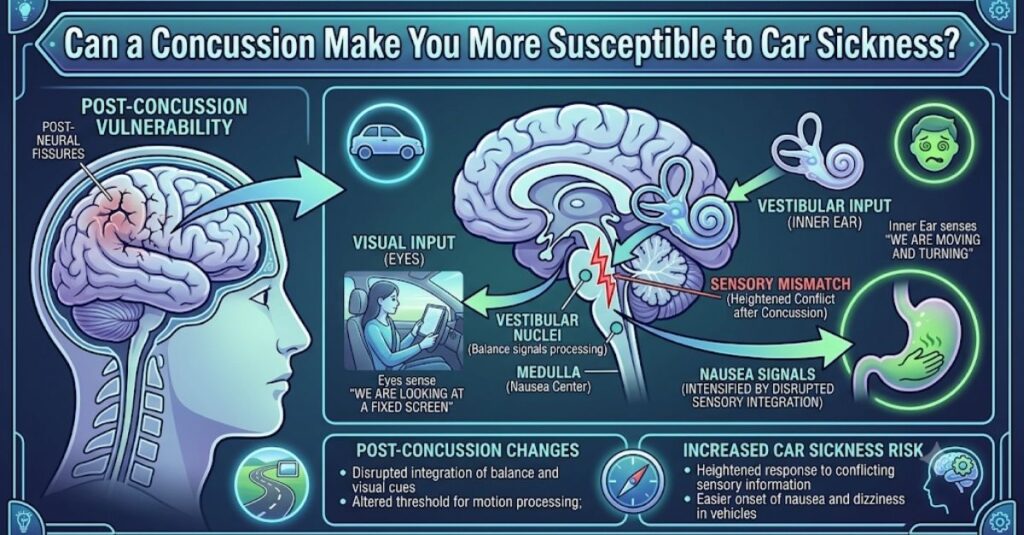
Your body maintains its balance through a complex partnership between your eyes and your inner ear (the vestibular system).
Inside your inner ear are three fluid-filled semicircular canals. When you move your head, the fluid sloshes, bending microscopic hair cells that instantly signal to your brain exactly how fast and in what direction you are moving.
During a concussion, the brain sustains a rapid acceleration and deceleration force—often with a rotational shear. This violent movement can physically damage the delicate neural pathways connecting your inner ear to your brainstem. Even if the inner ear itself is perfectly fine, the “wiring” that carries its signals to the brain is suddenly frayed and unreliable.
The Rise of “Visual Dependence”
Because the brain can no longer trust the static or delayed signals coming from the damaged vestibular system, it is forced to find a new way to keep you balanced. It does this by over-relying on your eyes.
This neurological shift is called visual dependence.
When you become visually dependent, your brain prioritizes what it sees over what it feels. This works reasonably well when you are walking around your quiet living room, but it creates absolute chaos the moment you step into a dynamic, moving environment like a car.
Why the Car Makes You Sick
When you are a passenger in a moving vehicle, the environment outside the window is rushing by at 60 mph. Because your concussed brain is overly dependent on vision, it tries to aggressively process all of that rapidly blurring scenery.
At the same time, the car is vibrating, stopping, and turning. Your brain cannot successfully integrate the chaotic visual blur outside with the physical bumps it feels. This massive sensory mismatch completely overwhelms your central nervous system, triggering visual vertigo, tension headaches, and severe nausea.
3 Ways to Ease Post-Concussion Travel
If you are recovering from a head injury, you have to be proactive about managing your sensory input during travel.
-
Control Your Visual Field: Do not sit in the back seat where your peripheral vision is flooded with moving windows. Sit in the front passenger seat and look straight ahead at the distant horizon. This provides a slow-moving, stable visual anchor.
-
Avoid Screens Entirely: Looking down at a smartphone or attempting to read forces your eyes to lock onto a static target while your body is jostled. For a concussed, visually dependent brain, this is a guaranteed trigger for instant dizziness.
-
Invest in Vestibular Therapy: A specialized physical therapist can guide you through targeted gaze stabilization and habituation exercises (like the Epley maneuver or VOR training) that actively repair and rewire the damaged neural pathways.
The Safest On-The-Go Defense: Acupressure
When your brain is already healing from trauma, the last thing you want to do is flood it with heavy, sedating medications. Traditional over-the-counter motion sickness pills act as central nervous system depressants. For a concussion survivor already battling brain fog and fatigue, these medications can make recovery significantly harder.
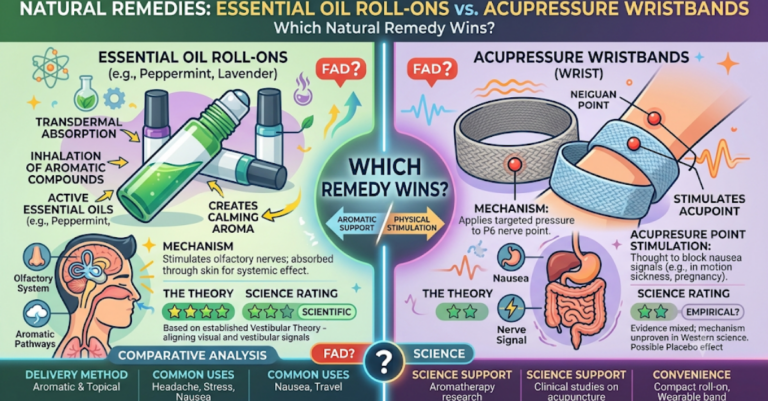
To intercept the nausea safely and stay clear-headed, acupressure is the ultimate everyday carry item.
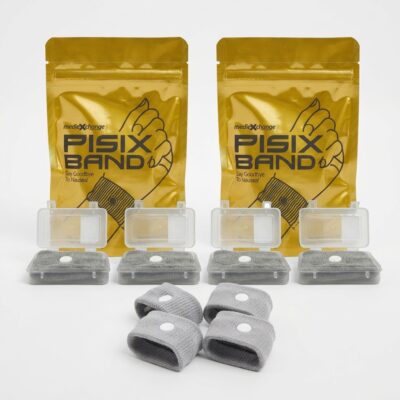
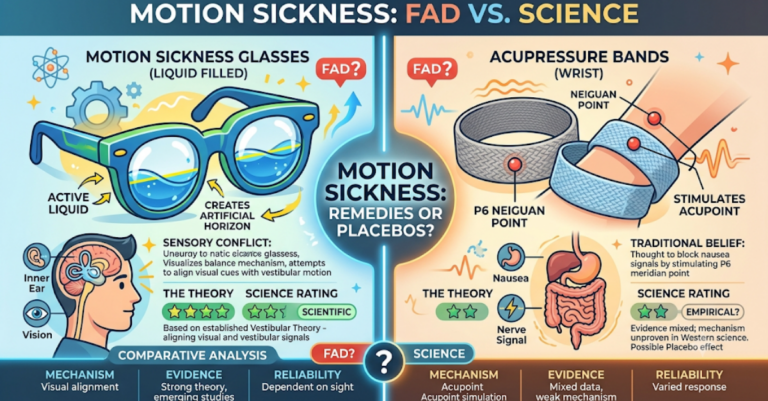
By wearing a Pisix Band, you can actively soothe your nervous system without chemical interference. Engineered by Mediexchange, the Pisix Band features a built-in precision stud that applies gentle, continuous pressure to the Nei-Kuan (P6) acupressure point on your inner forearm.
Stimulating this specific median nerve sends a grounding, calming signal directly to your brain, intercepting the sensory panic before it can trigger stomach spasms.
-
100% Drug-Free: Because it is a non-sterile wellness product that does not require Class A medical device registration, it is a highly accessible, safe option that won’t compound your post-concussion brain fog.
-
Continuous Relief: You can wear the comfortable stretch-fit bands all day, providing a steady baseline of defense against both car sickness and the dizziness caused by visually busy environments (like grocery stores or scrolling on a computer monitor).
-
Convenient & Ready: Designed for modern logistics, the bands ship efficiently in a compact 16.5x10x2 cm box. Whether you are ordering nationally via Amazon FBA or grabbing them locally through 10-minute quick-commerce apps like Blinkit right here in Indore, finding reliable relief has never been easier.