It is a common scenario on family road trips: the toddler is sleeping peacefully in their car seat, the parents are comfortably chatting up front, but the 8-year-old in the back is suddenly pale, sweating, and begging to pull over.
If you feel like motion sickness completely skipped the baby phase only to hit your elementary-schooler with a vengeance, you are actually observing human biology working exactly as it should.
Motion sickness is not a constant trait. Your susceptibility to it operates on a distinct biological bell curve that shifts as your nervous system matures. Here is the science behind why car sickness peaks in childhood, why it usually fades in adulthood, and how to protect your family’s travel plans at any age.
Phase 1: The Toddler Immunity (Ages 0-2)
It is incredibly rare for infants and toddlers under the age of two to experience motion sickness.
Motion sickness is caused by a sensory mismatch—when your eyes (what you see) and your inner ear (what you feel) send conflicting signals to the brain. However, to experience this mismatch, both of those systems need to be fully developed and communicating efficiently.
In infants, the central nervous system is still highly immature. Their brains simply do not have the complex neural pathways required to compare visual input against vestibular (inner ear) input in real-time. Because the brain isn’t processing the conflict, it doesn’t trigger the “panic and vomit” response.
Phase 2: The Peak Vulnerability (Ages 6-12)
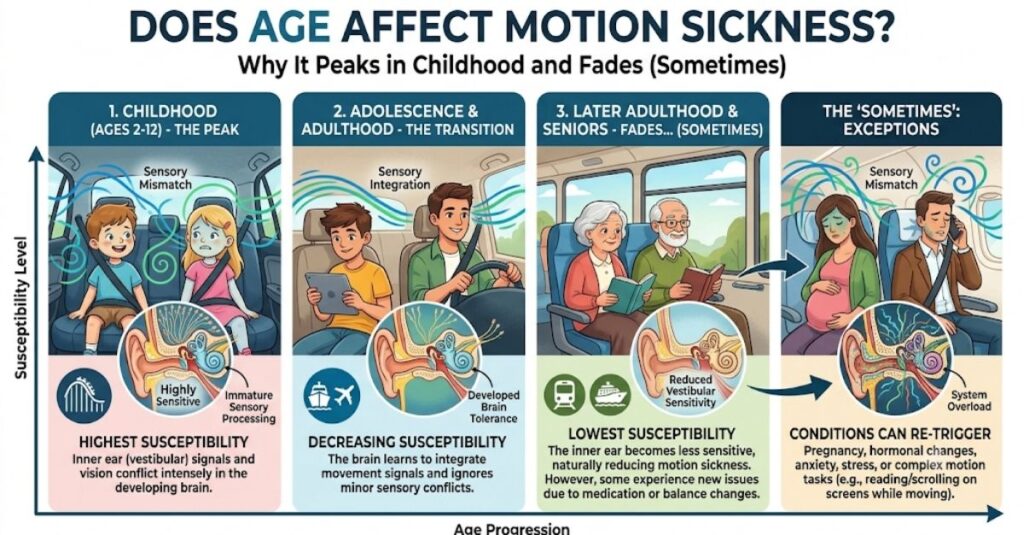
Between the ages of 6 and 12, the central nervous system fully matures, and the inner ear becomes highly sensitive to balance and movement. Suddenly, the brain is perfectly capable of detecting sensory conflicts—and it reacts aggressively.
This age group gets hit the hardest by car sickness for three reasons:
-
A “New” Sensation: The brain hasn’t yet learned that riding in a car is safe. When it receives conflicting data (feeling the bumps but seeing a static car interior), it reverts to its evolutionary default: it assumes the child has ingested a neurotoxin and triggers nausea to expel it.
-
The Height Disadvantage: Children are shorter. From the back seat, their line of sight is often blocked by the front seats, meaning they can’t easily look out the front windshield to sync their vision with the road’s movement.
-
The Screen Distraction: Kids in this age bracket are highly prone to looking down at tablets, phones, or books to entertain themselves. Locking their eyes onto a static screen while the body is in motion is the ultimate trigger for a sensory mismatch.
Phase 3: The Adult Fade (Ages 20+)
For most people, the severity of motion sickness drops off dramatically in their early twenties.
This happens through a neurological process called habituation. After years of riding in cars, trains, and boats, the adult brain eventually learns that the sensory mismatch of travel is not actually a neurotoxin. It stops hitting the panic button, allowing adults to ride comfortably.
Why It Sometimes Comes Back
While habituation protects most adults, motion sickness can suddenly return later in life. This is usually triggered by:
-
Hormonal Shifts: Surges in estrogen (during pregnancy or menstrual cycles) can temporarily heighten the brain’s nausea center.
-
Vestibular Degradation: As we enter our senior years, the fluid and sensory hair cells in the inner ear naturally begin to degrade, making it harder for the brain to process balance, which can re-trigger motion sickness in older adults.
The Ultimate Family-Friendly Fix: Acupressure
Managing motion sickness for a family can be difficult. Children often refuse to swallow pills, and traditional antihistamine medications (like Dramamine) act as central nervous system depressants. Giving these to a child—or taking them yourself—results in heavy sedation, ruining the first day of your vacation with extreme brain fog.
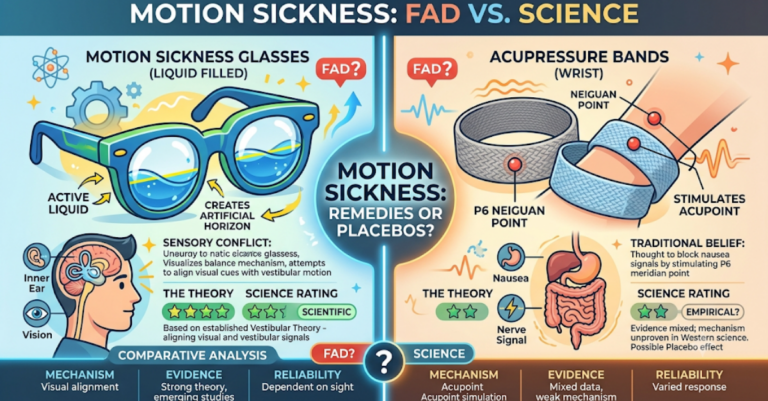
To keep the whole family alert and nausea-free, the best defense is a physical intervention: acupressure.
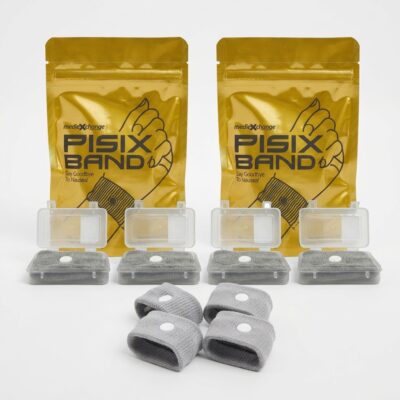
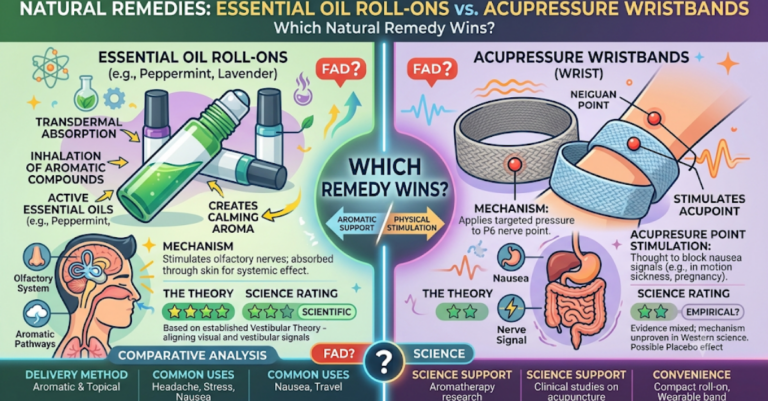
By wearing a Pisix Band, you can safely intercept the brain’s panic signals at any age. Engineered by Mediexchange, the Pisix Band is a comfortable, universal-stretch cotton wristband featuring a precision stud. This stud applies continuous pressure to the Nei-Kuan (P6) acupressure point on your inner forearm, sending a grounding signal to the central nervous system that actively blocks nausea.
-
100% Drug-Free: Because it is completely chemical-free, you don’t have to worry about dosing, side effects, or drowsiness for your kids. Furthermore, it is a non-sterile wellness product that does not require Class A medical device registration, making it highly accessible.
-
One Size Fits All: The stretch-fit cotton easily adapts to both a child’s wrist and an adult’s, making it a universal travel tool for the whole car.
-
Travel Ready Logistics: Packaged efficiently in a compact 16.5x10x2 cm box, it is easy to stash in the glovebox. Whether you are ordering nationally via Amazon FBA or relying on local quick-commerce apps like Blinkit right here in Indore before a school field trip, reliable defense is always ready to go.