When you are trapped in the passenger seat on a winding road, popping in your earbuds and closing your eyes is one of the best survival strategies. Blocking out the visual blur outside the window removes half of the sensory conflict that causes motion sickness.
But what you choose to play through those headphones matters just as much as closing your eyes.
If you find yourself getting dizzy while listening to an intense true-crime podcast, but feel perfectly fine when listening to a lo-fi playlist, it is not a coincidence. Your brain processes spoken word and musical rhythms in entirely different ways. Here is the biological breakdown of why audio choice impacts your nausea, and which one you should queue up for your next commute.
The Brain on Overload
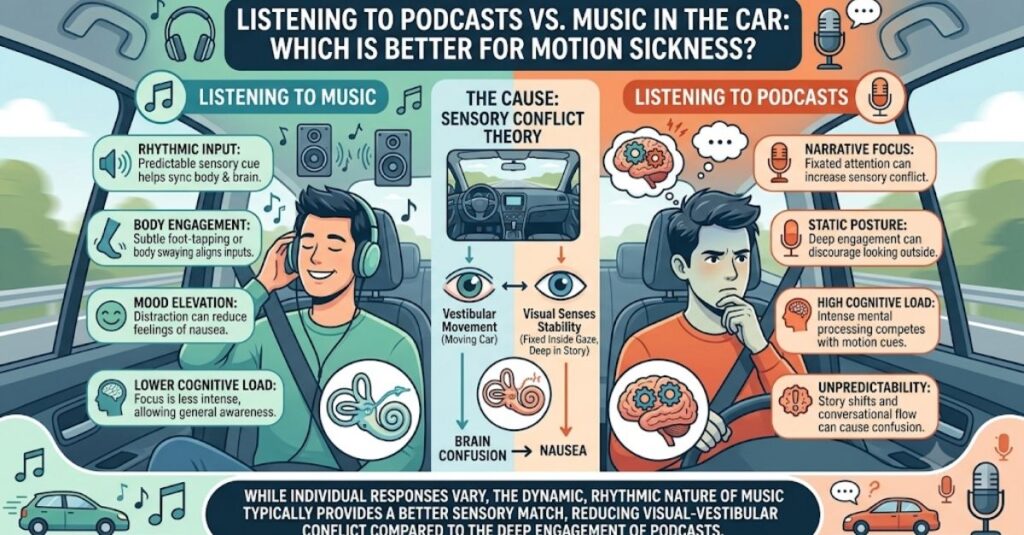
All motion sickness begins with a sensory mismatch. Your inner ear feels the physical bumps, acceleration, and turns of the car, but your eyes (if looking inside the cabin) tell your brain you are sitting still.
When your central nervous system tries to reconcile this violently conflicting data, it uses up a massive amount of processing power. If the brain gets overwhelmed, it hits the panic button, triggering the autonomic nervous system to release histamine and induce nausea.
To prevent this panic, you have to lower your brain’s cognitive load.
Podcasts: The Cognitive Overload Trap
Podcasts are fantastic for passing the time, but they demand active cognitive engagement.
When you listen to a podcast, your brain’s language processing centers (like Wernicke’s and Broca’s areas) are working in overdrive. You are tracking narratives, processing new vocabulary, interpreting tone, and visualizing scenarios.
-
The Problem: Your brain is already fighting a neurological war between your inner ear and your visual system. Forcing it to simultaneously process a complex, high-energy podcast drains your central nervous system’s limited bandwidth.
-
The Result: This cognitive exhaustion drastically lowers your nausea threshold, meaning it takes fewer bumps in the road to make you feel sick.
Music: The Rhythmic Anchor
Music, particularly tracks with a steady, predictable tempo, interacts with your nervous system in a completely different way.
Instead of demanding active cognitive processing, music provides rhythmic grounding. Tracks with a tempo of 60 to 80 beats per minute (bpm) closely mimic a resting human heart rate. Listening to this tempo actively stimulates the parasympathetic nervous system (your “rest and digest” mode).
-
The Solution: Rhythmic music calms the vagus nerve, signaling to your brain that you are safe. It acts as an auditory anchor, distracting the brain from the sloshing fluid in your inner ear without causing cognitive fatigue.
The Ultimate Travel Combo: Music + Acupressure
Switching your audio from a heavy podcast to a relaxing playlist is a great first step, but sound alone cannot physically stop your inner ear from detecting motion. If you want to guarantee a comfortable ride without relying on drowsy chemical antihistamine pills, you need to combine your audio anchor with a physical one.
The most effective, drug-free way to intercept the nausea signal is acupressure.
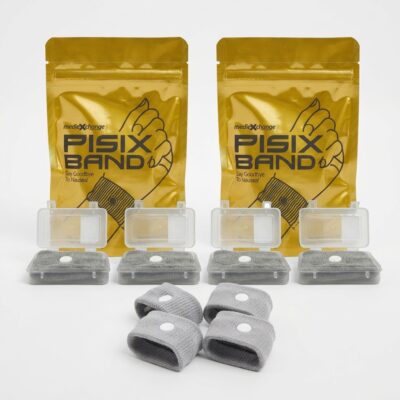
By wearing a Pisix Band, you can safely hit the override switch on your nervous system. Marketed by Mediexchange, the Pisix Band features a built-in precision stud that applies continuous, gentle pressure to the Nei-Kuan (P6) acupressure point on your inner forearm.
Stimulating this specific median nerve sends a steady, grounding touch signal directly to your central nervous system, physically blocking the nausea-inducing distress signals before they reach your stomach.
Why It Belongs on Your Next Drive
-
Clear-Headed Focus: It is 100% chemical-free. You get powerful relief without the extreme brain fog of traditional motion sickness pills.
-
Highly Accessible: Because it is a non-sterile wellness product that is not required for registration as a Class A medical device, you do not need a prescription or clinical visit to get safe, everyday defense.
-
Ready for the Road: Engineered for modern logistics, the bands ship in a compact 16.5x10x2 cm box. Whether you are ordering nationally via Amazon FBA or grabbing a pair locally through quick-commerce apps like Blinkit right here in Indore, you can secure real relief exactly when you need it.