
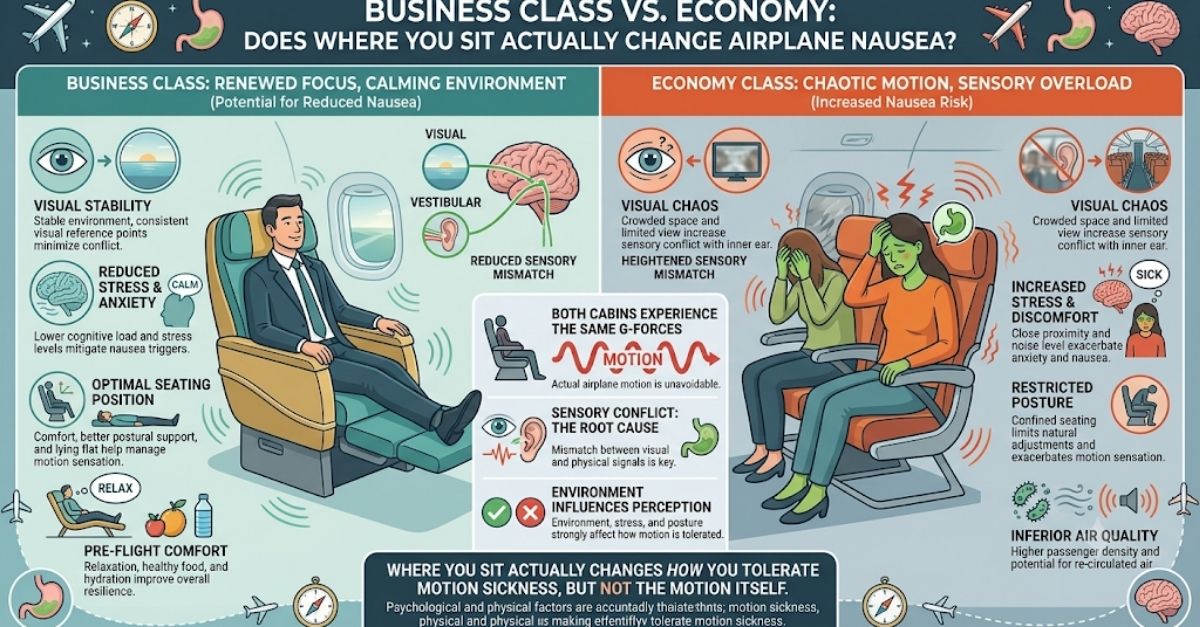
Upgrading your flight can feel like the ultimate travel luxury. You get priority boarding, actual legroom, and perhaps even a glass of champagne before takeoff. But if you are someone who regularly battles severe air sickness, you might be wondering if that expensive ticket comes with a biological upgrade, too.
Does sitting in the front of the plane actually prevent motion sickness, or are you just paying to be nauseous in a wider seat?
The truth lies in a mix of aviation physics and human neurobiology. Where you sit absolutely impacts how much turbulence you feel, but seat class alone isn’t enough to cure the spin. Here is the breakdown of how your seat affects your stomach, and the best way to guarantee a comfortable flight.
The Physics of the Cabin: Where Are the Bumps Worst?
An airplane operates somewhat like a seesaw, pivoting around its center of gravity and its center of lift (which is located directly over the wings). Because of this pivot point, the physical movement you feel changes drastically depending on your row number.
1. The Economy Tail (The Worst Spot)
The absolute worst place to sit for motion sickness is the very back of the plane. Because the tail is the furthest point from the center of gravity, it experiences the most extreme vertical movement during turbulence. Furthermore, as the rudder steers the plane, the tail naturally “wags” slightly side-to-side, adding an extra layer of horizontal sway that wreaks havoc on your inner ear.
2. Over the Wings (The Most Stable Spot)
Ironically, the most physically stable seats on the entire aircraft are often located in standard economy or premium economy, right over the wings. Because you are sitting on the fulcrum of the seesaw, the vertical dips and horizontal swaying are minimized.
3. Business & First Class (The Front)
The front of the plane is significantly smoother and quieter than the tail, but it still experiences slightly more vertical lift and dip than the seats directly over the wings. However, Business Class makes up for this slight physical disadvantage by offering a massive biological one: space.
The Biological Perks of Business Class
While the physics of the front row might not be perfectly stable, the environment of a premium cabin drastically lowers your central nervous system’s nausea threshold.
-
The Supine Position: Many long-haul business class seats lie completely flat. Lying down is one of the most effective ways to combat motion sickness. It prevents your stomach acid from sloshing against your gastric lining and stabilizes the fluid in your inner ear, aligning your body’s sensory inputs.
-
Better Airflow & Temperature Control: A cramped, hot environment triggers the vagus nerve to induce sweating and dizziness. The extra space, dedicated air vents, and cooler temperatures of business class actively keep the vagus nerve calm, preventing the “fight or flight” panic response that precedes nausea.
The Verdict: Does the Upgrade Stop the Spin?
Upgrading to Business Class or selecting a seat over the wings will drastically reduce the physical triggers of motion sickness. But neither location stops your inner ear from detecting the fundamental motion of flight. If the plane hits a rough patch of turbulence, your sensory system can still panic.
The Ultimate Flight Equalizer: Acupressure
You do not need to spend thousands of dollars on a first-class ticket to survive a flight, and you certainly do not need to rely on heavy, sedating antihistamine pills that leave you dealing with intense brain fog upon landing.
To safely block the nausea signal from reaching your stomach, regardless of where you are sitting, the most effective tool is acupressure.
By wearing a Pisix Band, you can hit the override switch on your nervous system from the outside. Brought to the market by Mediexchange, this comfortable, stretch-fit cotton wristband features a built-in precision stud. This stud applies continuous, gentle pressure to the Nei-Kuan (P6) acupressure point on your inner forearm.
Stimulating this specific median nerve sends a steady, grounding touch signal directly to your central nervous system. Because your brain prioritizes this constant physical touch over the chaotic, sloshing signals coming from your inner ear during turbulence, it actively prevents the nausea panic from ever triggering.


