
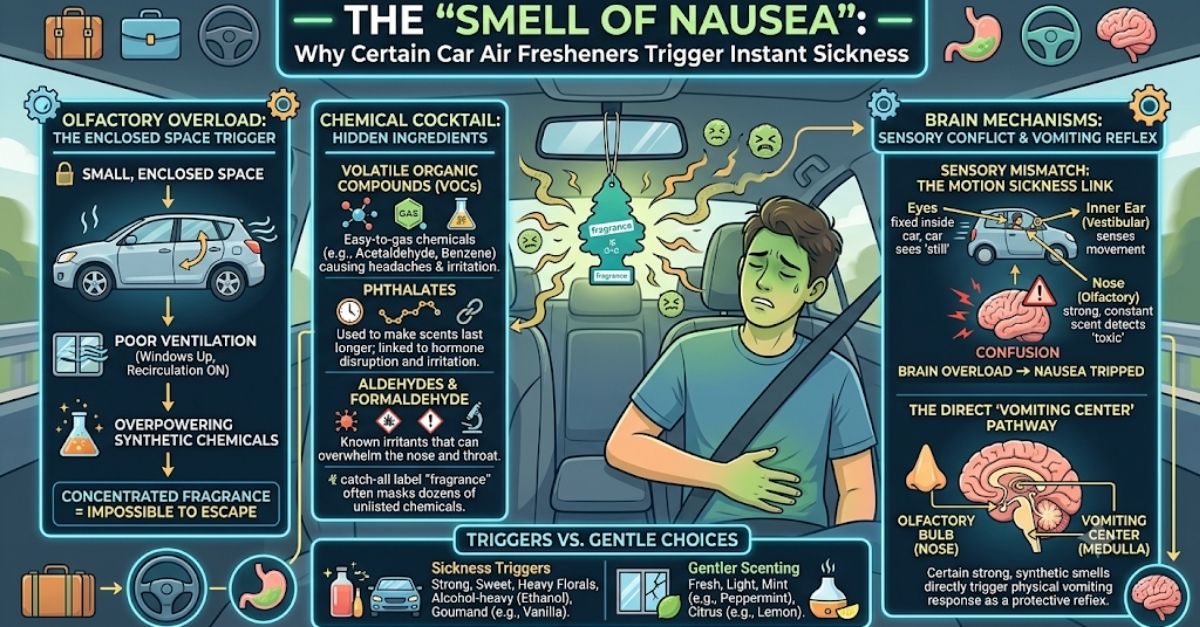
You open the door to a rideshare or step into a friend’s freshly detailed car, and before the engine even turns over, it hits you. A heavy, artificial wave of “Black Ice,” synthetic vanilla, or fake pine aggressively assaults your senses. Within seconds, your mouth waters, a tension headache grips your temples, and your stomach completely drops.
Many people assume motion sickness only happens when a vehicle is moving. But if you have a highly sensitive nervous system, the mere smell of a car can trigger a severe nausea attack before you ever leave the driveway.
It is not in your head, and it is not an overreaction. It is raw neurobiology. Here is the science behind why certain air fresheners make you instantly sick, and how you can override the olfactory panic.
The Olfactory Superhighway
To understand why a cheap air freshener can ruin your day, you have to look at how your brain processes smell.
Unlike your other senses (which are routed through the brain’s thalamus to be filtered and processed), your sense of smell has a VIP pass. Scent molecules travel straight up your nasal cavity to the olfactory bulb, which is directly connected to two critical brain areas:
-
The Amygdala: The center for emotional memory and the “fight or flight” panic response.
-
The Area Postrema: The brain’s literal vomiting center.
Because there is almost zero processing delay, a toxic or overwhelming scent can trigger a stomach spasm faster than a bumpy road ever could.
The Chemical Culprits: VOCs
The primary reason car air fresheners cause nausea is that they aren’t actually made of vanilla, pine, or citrus. They are complex cocktails of synthetic chemicals.
Most hanging or vent-clip air fresheners heavily emit Volatile Organic Compounds (VOCs)—including formaldehyde, benzene, and synthetic phthalates. In the enclosed, poorly ventilated cabin of a car, these VOCs become highly concentrated.
When you inhale these synthetic chemicals, they aggressively irritate your trigeminal nerve (the nerve responsible for sensations in your face and head). This immediate irritation is what causes the sharp tension headache, which your brain instantly translates into a wave of nausea to warn you of a toxic environment.
Classical Conditioning: The “Ghost” Nausea
There is another fascinating biological reason you might get sick from air fresheners: Pavlovian Conditioning.
If you experienced severe car sickness as a child in a family minivan that always had a strawberry air freshener hanging from the rearview mirror, your brain permanently linked those two experiences. Decades later, your amygdala remembers that the smell of artificial strawberry means “danger and vomiting.” The moment you smell it again, your brain proactively triggers nausea in a misguided attempt to protect you from the motion sickness it assumes is coming.
How to Stop the Olfactory Spin
You cannot always control the environment of the car you are riding in, but you can control how your central nervous system reacts to it.
Rolling down a window to clear the VOCs is the first step, but once your brain’s nausea center is activated, fresh air is rarely enough to stop the stomach spasms. You need to actively intercept the distress signal.
The most effective, drug-free way to hit the biological override switch is with acupressure.
By wearing a Pisix Band, you can ground your nervous system before the synthetic scents overwhelm you. Engineered by Mediexchange, the Pisix Band is a comfortable, stretch-fit cotton wristband featuring a precision stud. This stud applies continuous pressure to the Nei-Kuan (P6) acupressure point on your inner forearm.
Stimulating this specific median nerve sends a powerful, steady touch signal directly to your central nervous system. This physical input essentially “closes the gate,” preventing the panicked signals triggered by the olfactory bulb from reaching your stomach.


