
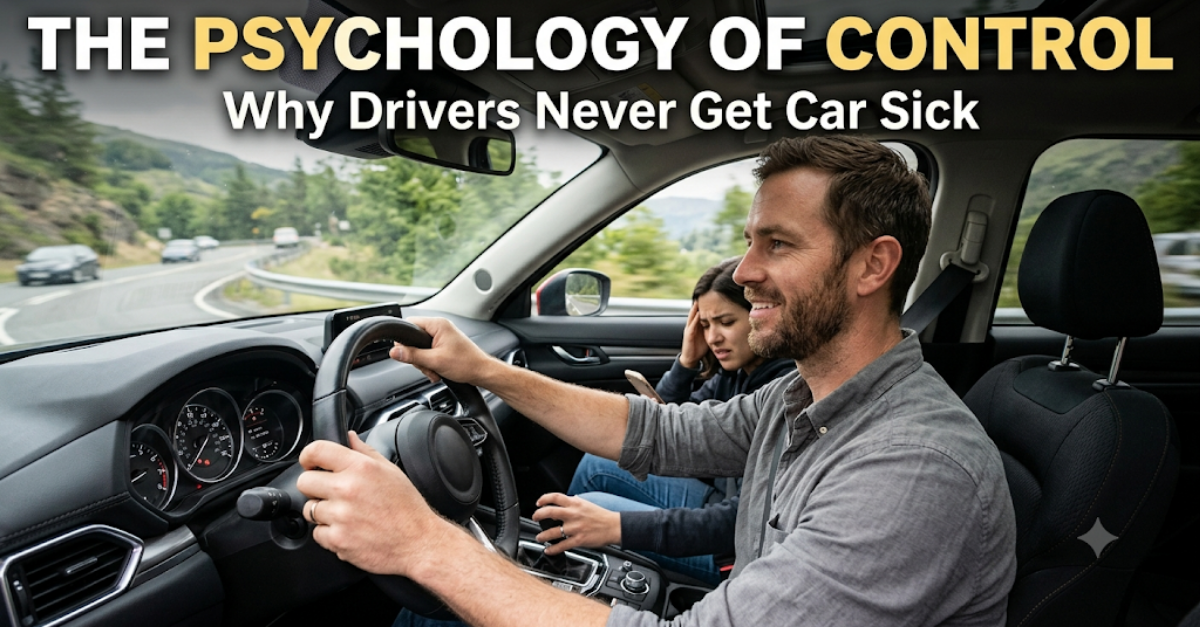
It is a paradox that almost every motion sickness sufferer has experienced: you can spend two hours aggressively navigating hairpin mountain roads from the driver’s seat and feel absolutely fantastic. But the second you hand over the keys and sit in the passenger seat, a ten-minute trip to the grocery store leaves you dizzy, sweating, and fighting the urge to throw up.
Why does your stomach suddenly revolt just because you moved three feet to the right?
While we often blame the physics of the passenger seat, the real culprit is psychological. When you stop driving, your brain fundamentally changes how it processes motion, anxiety, and control. Here is the cognitive science behind why drivers are immune to the spin, and how you can hack your nervous system to survive the passenger seat.
The Locus of Control and Anxiety
Before we look at the physical motion of the car, we have to look at the emotional state of the brain. Psychologists refer to a concept called the locus of control—the degree to which you believe you have control over the outcome of events in your life.
When you are driving, your locus of control is entirely internal. You decide when to brake, how fast to take a turn, and when to accelerate. Because you are in control, your baseline anxiety is incredibly low.
When you sit in the passenger seat, you surrender that control. Even if you trust the driver implicitly, your subconscious brain is suddenly at the mercy of someone else’s unpredictable physical movements. This lack of control causes a subconscious spike in anxiety. Because anxiety and nausea are both regulated by the exact same neurological pathway (the vagus nerve), this psychological stress drastically lowers your body’s threshold for motion sickness.
The Efference Copy: Predictive vs. Reactive Processing
The psychological comfort of being in control is powerful, but it triggers a secondary biological superpower known as the efference copy.
Motion sickness is universally caused by a sensory mismatch (your inner ear feels movement, but your eyes see a static environment). When you are a passenger, you are completely blind to the car’s future movements. When the car suddenly swerves, your inner ear is caught off guard, and your brain is forced to violently react to the physical force.
When you drive, your brain doesn’t have to react; it predicts.
A fraction of a second before your hands turn the steering wheel, your motor cortex sends a duplicate of that movement command (the efference copy) directly to your inner ear and your visual system. It acts as an advanced warning system. When the car actually turns, the physical sensation perfectly matches the brain’s prediction. Because there is zero surprise, there is zero sensory panic.
Hacking the Passenger Seat: The Physical Anchor
You cannot always be the one driving. When it is your turn to sit in the passenger seat or the back of a rideshare, you need a way to replicate the grounding, anti-anxiety effects of driving without taking the wheel.
Swallowing a chemical antihistamine pill will force your brain to calm down, but it does so by heavily sedating your central nervous system. You lose the nausea, but you also lose your alertness to a thick cloud of brain fog.
To intercept the sensory mismatch naturally and keep your head perfectly clear, the most effective tool is acupressure.
By wearing a Pisix Band, you can safely hit the override switch on your nervous system. Brought to the market by Mediexchange, this stretch-fit cotton wristband features a built-in precision stud that applies continuous, gentle pressure to the Nei-Kuan (P6) acupressure point on your inner forearm.
Stimulating this specific median nerve sends a steady, rhythmic touch signal directly to your central nervous system. This physical touch essentially replicates the psychological grounding effect of gripping a steering wheel. It tells your brain that you are physically anchored, effectively blocking the vagus nerve from triggering a nausea panic.


