Your workday is finally over, and you are ready to relax at home. But first, you have to survive the commute. As your car creeps onto the highway and you hit the inevitable wall of red brake lights, a familiar feeling sets in. Your head gets heavy, a dull headache begins at your temples, and a wave of nausea makes your stomach churn.
Rush hour is stressful enough without adding physical sickness to the mix. If you normally feel fine driving at highway speeds but immediately feel dizzy the moment you hit a traffic jam, you are dealing with a very specific type of motion sickness.
Here is the biology behind why the “stop-and-go” traffic headache happens, and the best actionable, drug-free strategies to get you home without the nausea.
The Biology of the Brake Pedal
Like all forms of car sickness, traffic nausea is caused by a sensory mismatch in your brain. Your brain relies on your eyes, your inner ear (the vestibular system), and your muscles to understand how your body is moving through space.
When you are cruising at a steady 65 miles per hour, your inner ear eventually adapts to the constant speed, and your eyes easily track the smooth, passing horizon. Your systems are in sync.
Stop-and-go traffic completely shatters that synchronization:
-
The Vestibular Whiplash: Every time the car accelerates, your inner ear feels the forward thrust. A few seconds later, the car brakes, and your inner ear feels the sudden deceleration. This rapid, repetitive shifting violently throws your balance center out of whack.
-
The Visual Blockade: In a traffic jam, your view of the distant horizon is usually blocked by the trunk of the car or semi-truck directly in front of you.
Your inner ear is screaming, “We are constantly jerking forward and stopping!” while your eyes, staring at the stationary bumper ahead of you, tell your brain, “We are barely moving.” Your brain panics at this conflicting data and triggers a defensive nausea and headache response.
Why Rush Hour is the Perfect Storm
Beyond the sensory mismatch, commuting in heavy traffic introduces several other environmental factors that actively accelerate nausea:
-
Exhaust Fumes: Idling in a sea of cars means your vehicle is pulling in concentrated exhaust fumes. The smell of gasoline and carbon monoxide can instantly trigger an already sensitive stomach and intensify a tension headache.
-
The Phone Trap: Because traffic is moving at a crawl, we instinctively reach for our phones to check emails or change a podcast. Staring at a tiny screen while your body experiences the microscopic jolts of a braking car is the fastest way to induce severe eye strain and dizziness.
-
Commuter Stress: Frustration and anxiety cause your core temperature to spike and your heart rate to elevate—two physical states that make your digestive tract highly sensitive and prone to spasming.
How to Survive the Gridlock
You cannot control the traffic, but you can actively manage your environment to keep your senses aligned. Use these immediate tactics the next time you see brake lights ahead:
1. Shift Your Visual Anchor
Do not stare at the license plate of the car directly in front of you. Shift your gaze to look through the windshields of the cars ahead, or focus on the tops of the trees or buildings in the distance. Giving your brain a stable, distant visual anchor helps your eyes match the sudden jolting motions your inner ear is feeling.
2. Take Control of the Airflow
The moment traffic slows down, roll your windows up to block out the exhaust fumes of the surrounding cars. Turn on your car’s AC and make sure the air recirculation button is turned off so you are pulling in fresh air. Point the coldest vents directly at your face and neck; a drop in body temperature acts as a physical reset button that actively suppresses the vomit reflex.
3. Smooth Out Your Pedals
If you are the one driving, adjust your style. Instead of accelerating to close every small gap and slamming on the brakes, leave a larger cushion of space between you and the car ahead. Coast as much as possible. A smoother ride creates less vestibular whiplash for your inner ear.
The Ultimate Commuter Tool: Acupressure Bands
If you face a brutal, gridlocked commute every single day, relying on over-the-counter motion sickness pills is not an option. Medications like Dramamine cause heavy drowsiness, making it unsafe to operate a vehicle and leaving you exhausted before you even walk through your front door.
For fast, clear-headed relief, acupressure is the ultimate everyday carry item.
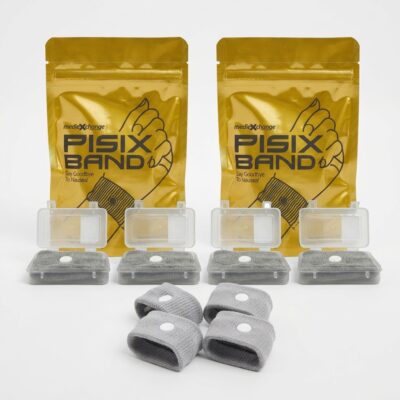
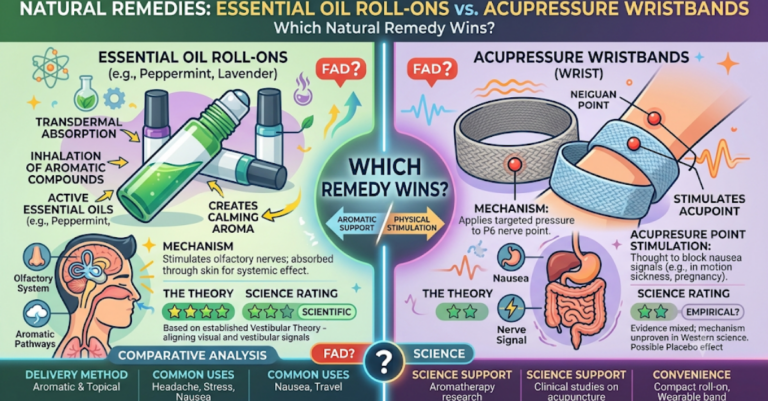
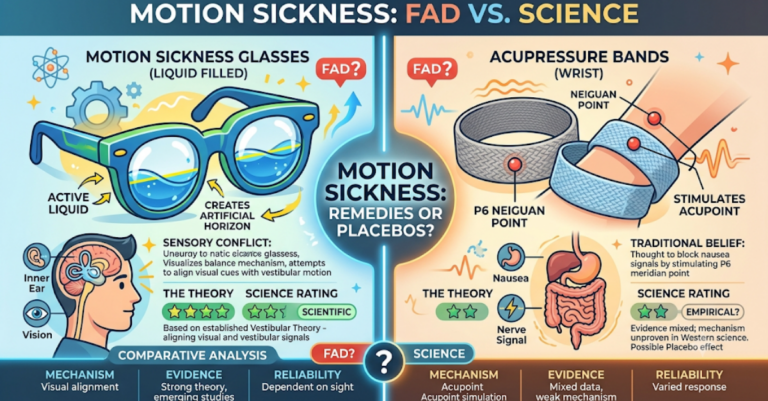
Using a drug-free wearable, like the Pisix Band, allows you to intercept nausea safely. The band features a built-in stud that applies gentle, continuous pressure to the Nei-Kuan (P6) acupressure point on your inner forearm.
Stimulating this specific median nerve sends a calming, grounding signal to your brain that actively blocks the nausea signals traveling to your stomach.
-
Zero Brain Fog: Because it is 100% chemical-free, you retain your sharp focus, ensuring you stay alert and safe behind the wheel.
-
Instant Activation: You don’t have to wait for a pill to kick in. You can slip the bands on the moment traffic slows down for rapid relief.
-
Discreet Comfort: The universal stretch-fit cotton design looks like a simple athletic sweatband, making it comfortable and unnoticeable to wear with your professional attire.