
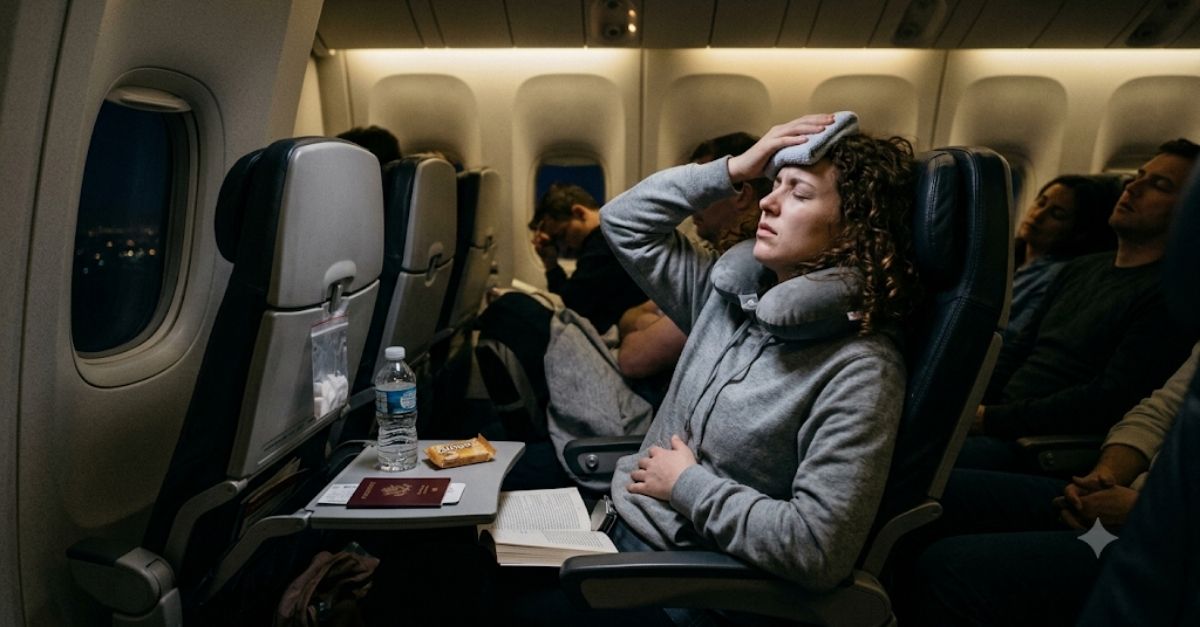
Boarding an ultra-long-haul flight can feel like preparing for a physical endurance event. Spending 15 hours inside a pressurized metal tube crossing multiple time zones is exhausting under the best circumstances. But if you are prone to motion sickness, the journey transforms from a boring marathon into a biological nightmare.
Combining the circadian disruption of jet lag with the sensory chaos of airplane turbulence creates the perfect storm for your central nervous system. Your brain is not only fighting the physical motion of the aircraft, but it is also battling severe sleep deprivation.
If you want to step off the plane in a new country ready to explore rather than ready to collapse, you have to treat both biological threats simultaneously. Here is the scientific guide to surviving a 15-hour flight without chemical hangovers or a churning stomach.
The Double Threat: Why Jet Lag Makes Nausea Worse
To survive the flight, you have to understand how these two biological phenomenons interact.
Jet lag is a disruption of your circadian rhythm. When you cross multiple time zones rapidly, your brain’s internal clock (which regulates cortisol and melatonin) completely desyncs from the actual sunlight outside. This causes extreme fatigue, cognitive fog, and systemic inflammation.
Motion sickness is caused by a sensory mismatch. Your inner ear feels the physical sway and turbulence of the aircraft, but your eyes (staring at the seatback screen) tell your brain you are sitting still. The brain panics at this conflicting data and triggers the vagus nerve to spasm your stomach.
The Compound Effect
When you are heavily fatigued from crossing time zones, your central nervous system’s threshold for sensory panic plummets. A mild bout of turbulence that might not bother you on a well-rested afternoon flight can easily trigger severe cold sweats and vomiting when your circadian rhythm is collapsing over the Pacific Ocean.
Step 1: Pre-Flight Chronotherapy (Beating the Jet Lag)
You cannot cure jet lag in the air, but you can manipulate your body clock to drastically soften the blow.
-
The Fasting Hack: Your digestive system has its own circadian clock. Fasting for 12 to 16 hours before you land, and then eating a high-protein meal at the exact time the locals are eating breakfast at your destination, acts as a biological “hard reset” for your internal clock.
-
Strategic Light Exposure: The moment you board the plane, change your watch to the destination time zone. If it is nighttime at your destination, put on a sleep mask and block all blue light. If it is daytime, keep the window shade open or stare at a brightly lit screen to suppress your melatonin production.
Step 2: In-Flight Nausea Defense (Beating the Spin)
Once you have your sleep strategy in place, you have to protect your stomach from the turbulence.
Taking traditional over-the-counter antihistamine pills (like dimenhydrinate) on a 15-hour flight is a massive mistake. These pills are central nervous system depressants. They will heavily sedate you, causing severe dehydration and dry mouth. More importantly, the chemical brain fog they induce will compound with your jet lag, leaving you feeling like a zombie for a full 24 hours after you land.
To safely block the nausea signal and keep your head perfectly clear to fight the jet lag, the ultimate tool is acupressure.
By wearing a Pisix Band, you can safely hit the override switch on your nervous system. Marketed by Mediexchange, this stretch-fit cotton wristband features a built-in precision stud that applies continuous, gentle pressure to the Nei-Kuan (P6) acupressure point on your inner forearm.
Stimulating this specific median nerve sends a steady, rhythmic touch signal directly to your central nervous system. Because your brain prioritizes this constant physical touch over the chaotic signals coming from your sloshing inner ear, it actively “closes the gate” on the vagus nerve, preventing the stomach spasms before they start.


