
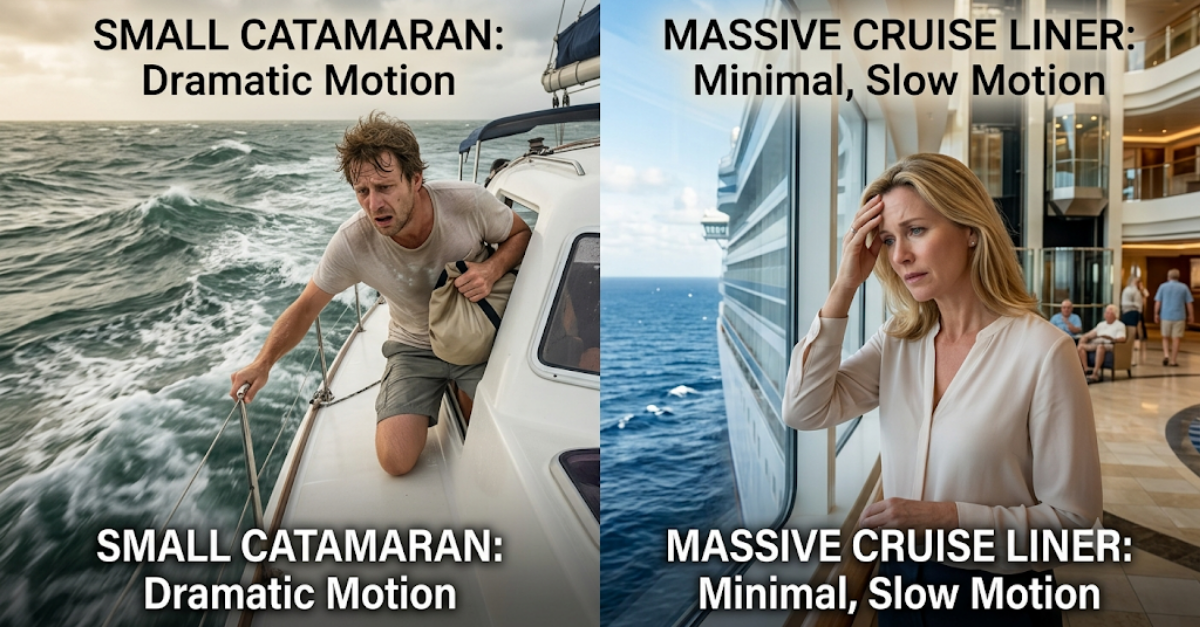
Booking a vacation on the water is a dream for many, but for travelers prone to motion sickness, the ocean represents a terrifying biological gamble.
When trying to minimize the risk of seasickness, many people assume that the type of boat doesn’t matter—they believe that water is water, and motion is motion. However, the physical dynamics of a small, lightweight catamaran and a massive, modern cruise liner are entirely different. They interact with the waves differently, and more importantly, they trigger completely different neurological responses in your inner ear.
If you are trying to decide which type of vessel is safer for a sensitive stomach, here is the scientific breakdown of high-frequency versus low-frequency motion, and how to protect yourself on either craft.
The Catamaran: High-Frequency Snap
Catamarans are incredibly popular for island-hopping and coastal excursions because they are fast, agile, and draw very little water.
The Physics of the Double Hull
Unlike a traditional monohull boat that slices through the water and rolls heavily from side to side, a catamaran has two parallel hulls. This twin-hull design provides a wide, stable base that almost entirely eliminates the deep, side-to-side “rolling” motion that causes traditional seasickness.
However, because they are so light and sit directly on top of the water, catamarans suffer from a different problem: high-frequency pitching and yawing.
When a catamaran hits a wave, the wide base forcefully snaps the boat back to a level position. Instead of a slow sway, you experience rapid, jerky, “snap-back” movements. This high-frequency motion rapidly exhausts the microscopic hair cells in your inner ear (the vestibular system). The rapid jolts make it incredibly difficult for your brain to establish a sensory baseline, leading to sudden, sharp spikes of nausea.
The Cruise Liner: The Floating City
Modern cruise liners are engineering marvels designed specifically to defeat the ocean’s natural movement.
Massive Displacement and Stabilizers
A massive cruise ship displaces hundreds of thousands of tons of water and is equipped with advanced underwater stabilizing fins. These ships simply crush through smaller waves, completely eliminating the rapid, jerky movements of a catamaran.
However, they cannot defy physics entirely. Instead of high-frequency snapping, massive cruise ships suffer from low-frequency heave and sway.
When a cruise ship hits large ocean swells, the entire vessel undergoes a slow, rhythmic rise and fall—much like an incredibly slow elevator. While this motion is gentle, the human brain is highly sensitive to low-frequency vertical drops. The slow “elevator drop” feeling causes a profound sensory mismatch between your inner ear and your eyes, often leading to a deep, prolonged, and exhausting type of nausea that builds over several hours.
See the Physics in Action
To understand why your inner ear reacts differently, use this interactive simulation to compare how hull width and mass affect a vessel’s physical movement over the exact same wave conditions.
Key Insight: Catamarans create rapid, unpredictable vestibular chaos, while cruise ships create a slow, rhythmic vertical drop. Both trigger the brain’s panic response, just at different speeds.
The Verdict: Which is Worse?
The “worse” vessel entirely depends on your personal biology. If you get sick in stop-and-go traffic or on winding roads, the rapid, jerky motion of a catamaran will likely trigger your nausea instantly. If you get dizzy on Ferris wheels or elevators, the slow, heaving sway of a massive cruise liner will be your biggest threat.
The Ultimate Defense: Intercepting the Vagus Nerve
Whether you are battling the quick snap of a catamaran or the slow roll of a cruise ship, the biological result is the same: a sensory mismatch causes your brain to panic and send a distress signal down the vagus nerve, commanding your stomach to spasm.
Taking traditional over-the-counter antihistamine pills can temporarily stop this, but they act as heavy central nervous system depressants. You will trade your nausea for extreme drowsiness, dry mouth, and brain fog—ruining your vacation before it even begins.
To intercept the nausea signal without chemical side effects, the ultimate biological tool is acupressure.
By wearing a Pisix Band, you can safely hit the override switch on your nervous system from the outside. Brought to the market by Mediexchange, this stretch-fit cotton wristband features a built-in precision stud. This stud applies continuous, gentle pressure to the Nei-Kuan (P6) acupressure point on your inner forearm.
Stimulating this specific median nerve sends a steady, rhythmic touch signal directly to your central nervous system. Your brain prioritizes this constant physical touch over the chaotic, sloshing signals coming from your inner ear. This immediately “closes the gate” on the vagus nerve, effectively blocking the sensory panic from ever reaching your stomach.


