For millions of commuters, the subway is the fastest, most efficient way to navigate a crowded city. But for those prone to motion sickness, descending into an underground station is the start of a daily battle.
The screeching brakes, the sudden lurches, and the flickering tunnel lights can turn a simple 15-minute ride into a miserable test of endurance. Sweating through your work clothes while fighting the urge to throw up is no way to start your morning.
If you can ride in a car or a bus without issue but immediately feel green on a train, you are experiencing a highly specific environmental trigger. Here is the science behind why the subway makes your stomach churn, and the best drug-free strategies to survive the underground commute.
The Underground Sensory Trap
Motion sickness always boils down to a sensory mismatch in your brain. Your visual system (what your eyes see) and your vestibular system (what your inner ear feels) must send matching data to your brain for you to maintain equilibrium.
The subway strips away all the visual anchors you normally rely on:
-
The Missing Horizon: In a car or a bus, you can look out the window at the distant horizon to prove to your brain that you are moving forward. On a subway, the windows only show black, featureless tunnels or rapidly flashing support beams (which trigger a strobe effect that worsens dizziness).
-
The “Stationary” Car: Because there is nothing to look at outside, your eyes lock onto the stationary interior of the train car—the advertisements, the floor, or your phone. Your eyes tell your brain, “We are sitting completely still.”
-
Lateral Sway and Braking: Meanwhile, your inner ear feels the massive forward acceleration, the hard braking at every stop, and the aggressive side-to-side sway of the tracks.
Your brain panics at this violently conflicting data and triggers a nausea response. Combine this with a crowded, stuffy train car and poor air circulation, and you have the perfect recipe for severe motion sickness.
Subway-Specific Survival Tactics
You cannot fix the tunnel, but you can change how your body interacts with the motion of the train.
1. The Surfer’s Stance
If you cannot find a seat and have to stand, do not stand parallel to the doors with your feet firmly together. When the train brakes, you will be thrown violently forward, causing “vestibular whiplash.”
Instead, adopt a wide, staggered stance (one foot slightly in front of the other) and face the front of the train. Keeping your knees slightly bent allows your legs to act as shock absorbers, actively dampening the movement before it reaches your inner ear.
2. The Audio Pivot (Put the Phone Away)
Staring at a tiny, illuminated screen while your body is jostled in a dark tunnel is the absolute fastest way to induce severe eye strain and dizziness. Put your phone in your pocket the moment you board. If you need a distraction, switch entirely to audio—listen to a podcast, an audiobook, or a curated playlist.
3. Look Down the Aisle
If you are seated, do not stare at the person sitting directly across from you, and do not look out the black windows. Look straight down the long center aisle of the train car. This gives your visual system a deeper depth of field and allows your peripheral vision to track the subtle movements of the car, helping to bridge the gap between your eyes and your inner ear.
The Ultimate Commuter Hack: The Pisix Band
When you are commuting to an office or a university, taking traditional anti-nausea pills like Dramamine is a terrible option. The heavy drowsiness and brain fog they cause will leave you feeling exhausted and unfocused before your day even begins.
For fast, clear-headed, and discreet relief, the Pisix Band is the ultimate everyday carry item for subway commuters.
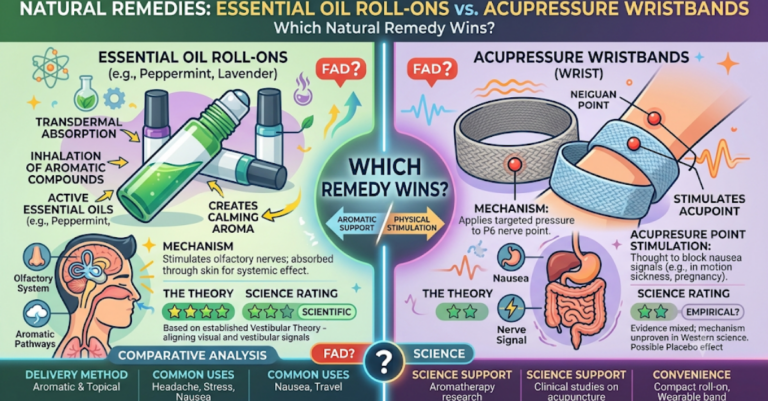
The Pisix Band is a soft, highly breathable cotton wristband that uses the proven science of acupressure to settle your stomach naturally. It features a carefully positioned stud that applies gentle, continuous pressure to the Nei-Kuan (P6) acupressure point on your inner forearm.
Stimulating this specific median nerve sends a steady, grounding signal to your central nervous system that actively intercepts and blocks the nausea signals traveling to your churning stomach.
Why It Belongs in Your Commuter Bag:
-
Zero Drowsiness: Because the Pisix Band is 100% chemical-free, you retain your sharp focus and energy. You arrive at your stop feeling alert and ready to work.
-
Instant Activation: You don’t have to wait 45 minutes for a pill to digest. You can slip the bands on as you walk down the station stairs to prevent sickness entirely, or put them on the moment the train starts swaying for rapid recovery.
-
Professional and Discreet: Designed to look like a simple, low-profile athletic sweatband, the stretch-fit cotton blends seamlessly under a jacket sleeve or blazer without drawing attention.