
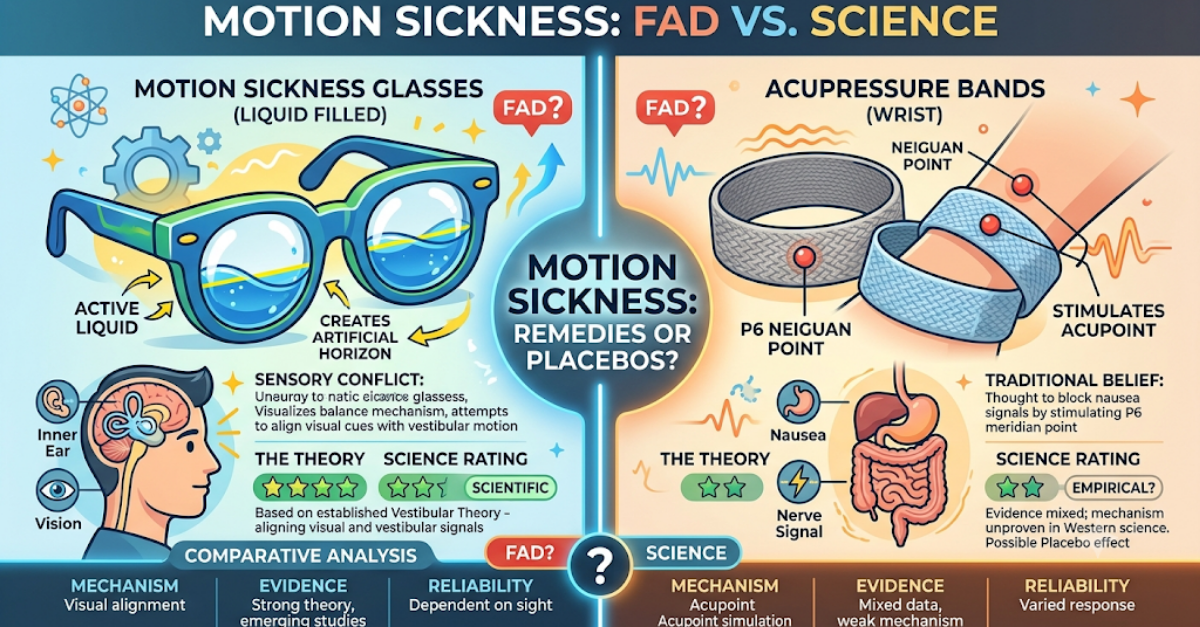
If you suffer from travel nausea, you know how quickly a dream vacation can turn into a nightmare. For decades, the primary solution was over-the-counter medication, which often leaves travelers feeling groggy, dehydrated, and sluggish.
As the demand for drug-free alternatives has surged, two prominent non-invasive solutions have taken center stage: the recently viral liquid-filled motion sickness glasses, and the long-established acupressure wristbands. But when it comes to finding real relief, how do you separate social media hype from scientifically backed solutions?
Here is a deep dive into the mechanisms, clinical backing, and practicality of both options.
The “Fad”: Liquid-Filled Motion Sickness Glasses
You have likely seen them on TikTok or Instagram: thick, circular plastic frames with four rings (two in the front, two on the sides) filled with bright blue liquid.
These glasses operate on a concept called visual recalibration. Motion sickness occurs when there is a sensory mismatch between what your eyes see (the static interior of a car or boat) and what your inner ear feels (the actual movement of the vehicle). The liquid inside the rims of the glasses moves with the vehicle, creating an “artificial horizon” in your peripheral vision. The goal is to trick your eyes into syncing up with your vestibular system.
The Drawbacks
While the theory behind an artificial horizon makes sense, the reality of wearing these glasses falls short for many travelers:
-
The Aesthetic Factor: There is no getting around it—they look ridiculous. Many adults feel far too self-conscious wearing them on a crowded flight or a train.
-
Impracticality: You have to put them on as soon as you feel sick and stare at a stationary object (like a book or phone) for 10 to 15 minutes until the nausea subsides, at which point you take them off. You cannot easily sleep or rest your head against a window while wearing them.
-
Limited Clinical Evidence: While some users report anecdotal success, these glasses lack the decades of rigorous, peer-reviewed clinical trials required to classify them as a definitive medical solution.
The “Science”: Acupressure Bands
Unlike viral gadgets, acupressure bands are rooted in centuries of Traditional Chinese Medicine (TCM) and validated by modern clinical research.
Acupressure bands work by applying continuous, firm pressure to the P6 (Nei-Kuan) point, located just below the wrist crease between the two central tendons. Modern science indicates that stimulating this specific nerve pathway sends signals directly to the brain, modulating the vagus nerve and calming the gastric rhythms that cause nausea and vomiting.
The Advantages
There is a reason reliable brands like the Pisix Band utilize this specific mechanism—it is practical, proven, and highly effective:
-
Decades of Clinical Backing: The P6 acupressure point is one of the most heavily researched non-pharmacological treatments for nausea. It is routinely recommended by doctors for morning sickness, post-operative nausea, and chemotherapy-induced nausea, long before travel sickness even enters the equation.
-
Discreet and Comfortable: A high-quality acupressure band looks just like a standard athletic sweatband. You can wear it under a long-sleeved shirt without drawing any unwanted attention.
-
Continuous Relief: You can put the bands on before your journey starts and leave them on the entire time—even while sleeping.
Head-to-Head Comparison
To understand why acupressure remains the gold standard for drug-free relief, it helps to visualize how these two options stack up across everyday travel metrics:
For a quick reference on how they operate:
| Feature | Liquid-Filled Glasses | Acupressure Bands |
| Core Mechanism | Visual recalibration (Artificial horizon) | Neurological stimulation (P6 acupressure) |
| Average Cost | $25 – $100+ | $10 – $20 |
| Durability | Fragile (Prone to leaking or cracking) | Highly durable (Washable elastic & plastic) |
| Best For | Short car rides where you are actively reading | Long-haul flights, cruises, sleeping, and everyday travel |
The Verdict
While liquid-filled glasses offer an interesting novelty and may provide relief for some, they ultimately fall into the category of a well-marketed fad. Their high price point, fragile design, and awkward aesthetics make them difficult to rely on for serious travel.
Acupressure bands, on the other hand, are grounded in well-documented science. They offer a discreet, highly affordable, and comfortable way to prevent nausea before it starts. If you want a reliable, drug-free travel companion that you can slip on and forget about, the science clearly points to your wrists, not your eyes.


