🎉 FREE shipping + Cash on Delivery on every order · Dispatch in 24 hrs
🎉 FREE shipping + COD · Dispatch in 24 hrs

Taking a high-speed train is one of the most efficient, comfortable ways to travel. Whether you are gliding across the Japanese countryside on a Shinkansen, weaving through Europe on a TGV, or utilizing modern commuter rails, the appeal is obvious: you bypass airport security and arrive directly in the city center.
But for all their engineering marvels, bullet trains introduce a unique biological challenge. Traveling at speeds exceeding 300 km/h (186 mph) while inside a perfectly smooth, quiet cabin can cause severe motion sickness, even for people who never get car sick.
If you have ever settled into a train seat only to find yourself instantly dizzy with a headache and a churning stomach, you aren’t imagining it. This is a highly specific form of travel nausea. Here is the science behind “bullet train dizziness” and the best natural ways to prevent it so you can enjoy the ride.
The extreme speeds of a bullet train interact with your body’s sensory systems in ways that standard cars and airplanes do not. The dizziness you feel is a classic sensory mismatch, supercharged by three specific environmental factors.
When you look out the window of a normal car, your eyes can easily track passing trees and signs. At 300 km/h on a bullet train, objects close to the tracks flash by in a massive blur. If you try to focus on the immediate foreground, your eyes are forced to dart back and forth incredibly rapidly—a reflex called optokinetic nystagmus. This rapid eye twitching exhausts your visual system in minutes, leading directly to severe eye strain, tension headaches, and nausea.
To maintain high speeds around curves without flying off the tracks, modern bullet trains employ active tilting systems. The train leans into turns like a motorcycle. Because the cabin is so quiet and smooth, your visual system (looking at the stationary seats inside the train) doesn’t register the turn. However, your inner ear (the vestibular system) feels the aggressive shift in gravity. This sudden clash between what you see and what you feel causes instant dizziness.
High-speed trains act like giant pistons when they enter tunnels, pushing massive amounts of air and creating rapid atmospheric pressure drops inside the cabin. This sudden pressure change causes your eardrums to flex inward. Because your inner ear is responsible for your balance, this physical squeezing of the eardrum can trigger sudden bouts of vertigo and stomach flips.
You can actively manage how your body processes the intense speeds of high-speed rail. Try these proven tactics on your next trip:
Look Deep into the Horizon: Never stare at the telephone poles or buildings immediately next to the tracks. Instead, focus your gaze on distant mountains, clouds, or the furthest point on the horizon. Distant objects appear to move much slower, giving your eyes a stable anchor that won’t trigger the optokinetic flicker effect.
Always Face Forward: Booking the right seat is critical. Riding backward forces your inner ear to process acceleration as deceleration, which violently scrambles your vestibular system. If you are traveling with a group and have facing seats, always claim the forward-facing spot.
Pop Your Ears Proactively: Do not wait for the tunnel pressure to give you a headache. The moment you see a tunnel approaching, start chewing gum, swallowing repeatedly, or yawning. Keeping your Eustachian tubes open prevents the sudden eardrum squeeze that causes vertigo.
If you are a frequent business traveler, taking over-the-counter motion sickness pills is a terrible strategy. Medications like Dramamine cause heavy drowsiness and delayed reaction times. You cannot afford to step off a high-speed train feeling exhausted and foggy when you have a business meeting or a full day of sightseeing ahead.
For fast, clear-headed relief, acupressure is the ultimate tool to keep in your travel bag.
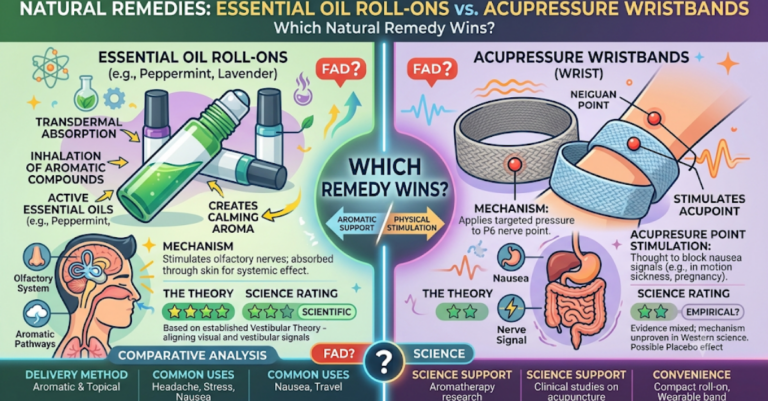
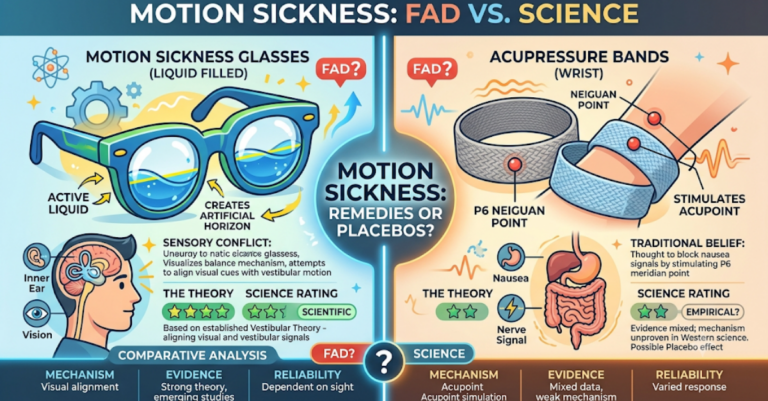
By wearing a Pisix Band, you can safely intercept train sickness without compromising your alertness. The band features a built-in stud that applies gentle, continuous pressure to the Nei-Kuan (P6) acupressure point on your inner forearm.
Stimulating this specific median nerve sends a steady, grounding signal to your central nervous system that actively overrides the dizziness caused by the train’s banking and speeds.
Zero Brain Fog: Because the Pisix Band is 100% chemical-free, you retain your sharp focus and energy from the station to your final destination.
Discreet & Professional: The stretch-fit cotton blends seamlessly under a blazer or jacket sleeve, making it unnoticeable during a business commute.
Easy Access Everywhere: Marketed by Mediexchange, the Pisix Band is designed for modern travel logistics. Packaged in a highly compact 16.5x10x2 cm box, it is easy to stash in any carry-on. Whether you order it nationally via Amazon FBA or grab it locally for an impending trip through a 10-minute delivery app like Blinkit, reliable relief is always within reach.
High-speed rail is the future of travel, and a sensitive stomach shouldn’t force you back onto crowded highways or tedious airport security lines. By managing your visual focus, choosing the right seat, and relying on the continuous, non-drowsy relief of the Pisix Band, you can sit back, relax, and enjoy the blur of the countryside flying by.