Flying a First-Person View (FPV) drone is the closest human beings can get to flying like a bird. By strapping on a pair of video goggles that stream a live feed directly from the nose of the drone, you can weave through dense forests, dive down the sides of skyscrapers, and race at highway speeds.
It is an incredibly exhilarating experience—until you take the goggles off and realize your head is spinning and your stomach is completely tied in knots.
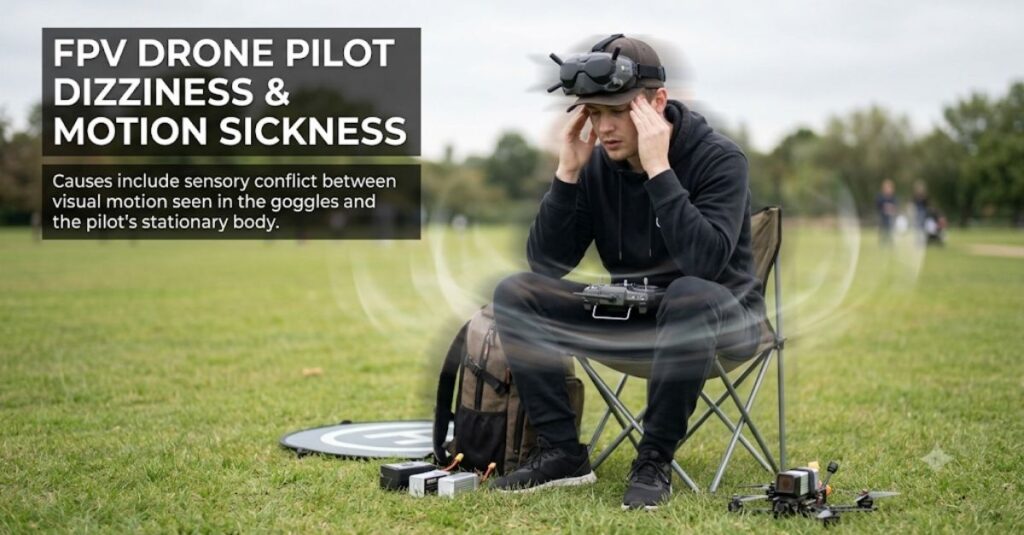
If you have ever tried flying an FPV drone and immediately felt like you were going to be sick, you aren’t alone. “Simulator sickness” or “cybersickness” is a massive hurdle for new pilots. Here is the biology behind why flying a drone can make the pilot physically ill, and the best ways to ground your senses so you can stay in the air.
The Biology of FPV Nausea
Motion sickness always boils down to a sensory mismatch. Your brain relies on two primary systems to understand how your body is moving: your eyes (the visual system) and your inner ear (the vestibular system).
When you fly an FPV drone, you are subjecting your brain to one of the most extreme sensory conflicts possible.
-
What Your Eyes See: You are soaring at 60 mph, doing barrel rolls, flipping upside down, and banking hard around trees.
-
What Your Inner Ear Feels: You are standing perfectly still in a park with your feet firmly planted on the grass.
Your brain receives this violently conflicting data and assumes something is horribly wrong. Evolutionarily, the only time your eyes and inner ear disagree this aggressively is if you have ingested a neurotoxin that is causing hallucinations. To protect you, your brain triggers a defense mechanism: it makes you nauseous so you will vomit up the “toxin.”
The “Latency Lag” Factor
To make matters worse, video feeds are not always instantaneous. Even the best FPV systems have a tiny amount of latency (delay) between what the drone camera sees and what the screens inside your goggles display. When you push the controller stick and your eyes experience a micro-stutter before the drone actually turns, that visual lag aggressively overloads your brain’s processing center, rapidly accelerating tension headaches and dizziness.
How to Prevent Drone Pilot Dizziness
If you want to master FPV flight, you have to actively manage your sensory input and build up your “VR legs.”
-
Always Fly Seated: Never stand up when flying FPV. When you stand, your brain relies heavily on your inner ear for balance. If your inner ear gets confused by the video feed, you will easily lose your footing and fall over. Sitting down in a comfortable camping chair gives your body a massive, stable physical anchor that helps ground your nervous system.
-
Start Slow and Level: Do not attempt acrobatic flips and dives on your first day. Start by flying slowly in a straight line, keeping the drone perfectly level. Let your brain gradually adapt to the sensation of forward visual motion without any aggressive banking.
-
Use a Desk Fan: If you are practicing on an FPV computer simulator at home before heading out to the field, point a small desk fan directly at your face. The physical sensation of the wind provides a real-world sensory anchor that helps bridge the gap between what you see on screen and what you feel.
The Ultimate Pilot’s Fix: Acupressure Relief
If you are highly susceptible to cybersickness, taking traditional over-the-counter anti-nausea pills before a flight session is a terrible idea. Medications like Dramamine cause heavy drowsiness and severely delay your reaction times. When you are piloting a heavy, fast-moving drone, you need lightning-fast reflexes.
To stay alert while keeping the nausea completely at bay, acupressure is the ultimate tool in your flight kit.
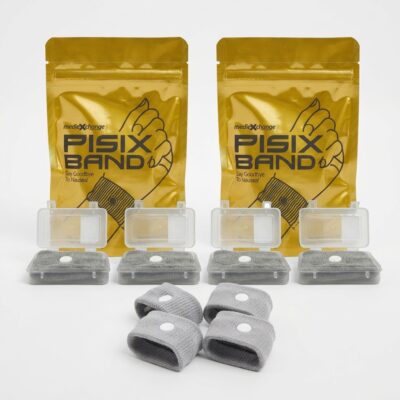
By wearing a Pisix Band while you fly, you can actively intercept the sensory mismatch. Engineered by Mediexchange, the band features a built-in stud that applies gentle, continuous pressure to the Nei-Kuan (P6) acupressure point on your inner forearm. Stimulating this median nerve sends a grounding signal to your central nervous system that actively blocks the nausea signals traveling to your churning stomach.
-
Zero Latency Reflexes: Because the band is 100% chemical-free, you will not experience any brain fog. Your thumb reflexes on the controller remain sharp and perfectly timed.
-
Highly Packable: When you are hauling a drone, batteries, and a transmitter, space is limited. Packaged efficiently in a compact 16.5x10x2 cm box, the Pisix Band easily slips into any drone carrying case.
-
Easy to Source: Whether you are ordering through Amazon FBA for national delivery or you need relief immediately before a weekend flight session via 10-minute quick-commerce apps like Blinkit right here in Indore, reliable defense against cybersickness is always accessible.
Conclusion
The thrill of FPV flight shouldn’t come at the cost of your stomach. By always flying seated, taking it slow, and utilizing the continuous, non-drowsy acupressure relief of the Pisix Band, you can conquer the sensory mismatch and enjoy the view from the clouds.