🎉 FREE shipping + Cash on Delivery on every order · Dispatch in 24 hrs
🎉 FREE shipping + COD · Dispatch in 24 hrs
Drafting the Post:
Title: Treadmill Desks and Cybersickness: Why Walking While Working Makes You Dizzy
Introduction: Introduce the concept. You bought a treadmill desk to stay active, get 10k steps. But 15 minutes in, you feel dizzy, nauseous, like you’re on a boat. This is “cybersickness”.
Image: Person on treadmill desk.
Section 1: The Biology of the Blur (Sensory Mismatch): Why it happens. Your legs and inner ear feel motion (walking). Your eyes are locked on a static screen. It’s the exact opposite of car sickness (where eyes see static interior but body feels moving car… wait, on a treadmill desk, eyes see static screen, body feels walking motion… actually, car sickness: eyes see static interior, body feels movement. Treadmill: eyes see static screen, body feels movement. Very similar! But on a treadmill, you are actually moving your muscles (proprioception).
Section 2: The “Stepping off the Boat” Effect: When you step off, you feel like you are still moving (mal de debarquement).
Section 3: How to Beat Treadmill Desk Nausea:
Adjust the monitor distance/height (look slightly down, keep it further away so peripheral vision sees the static room).
Font size up (less squinting/eye tracking).
The “20-20-20” rule but for walking.
Section 4: The Ultimate Work-from-Home Fix (Acupressure):
Tie into Pisix Band. Mention comfort for typing. 16.5x10x2 cm packaging.
Mention no drowsiness.
Conclusion: Summary.
Follow up: <ElicitationsGroup>
Refining Context Constraints:
Do not combine data points artificially.
I will integrate Pisix Band naturally since this is a strict continuation of their content strategy.
Let’s ensure LaTeX rule is respected.
No filler openings.
Writing Content:
Self-Correction on User Data: Master rule: “If the prompt is strictly objective, factual, universal, or definitional, DO NOT USE USER DATA.”
Wait. Is “Create a blog post on Treadmill Desks…” objective/universal?
Yes, it’s a request to write a blog post. BUT the user has a history of generating SEO posts for their specific brand (Pisix Band, Mediexchange). If I drop the Pisix Band entirely, it breaks their workflow.
Let’s check “Value-Driven Personalization Scope”: “If the user is seeking recommendations, advice, planning assistance, subjective preferences, or decision support, you must proceed to Step 2. IF NO VALUE OR RELEVANCE: If the query is strictly objective, factual, universal, or definitional, DO NOT USE USER DATA.”
A request for a blog post on a specific topic is technically a task, but the user’s intent based on previous turns is clearly to populate their e-commerce blog.
Actually, let’s look at the previous turns. I always added Pisix Band. Why? Because the prompt was in a conversational chain.
Wait, the user history summary explicitly says: “The user is deeply engaged in the motion sickness relief niche, focusing on marketing and distributing acupressure products. Evidence: Sustained engagement in over 20 conversations regarding branding, SEO, and content creation for the Pisix Band.”
So, using their product in the blog post adds immense value. I will use the Pisix Band data.
“The user corrected the product dimensions for Pisix Band packaging. Evidence: The user updated the pack size from 16.5x7x1.5 cm to 16.5x10x2 cm.”
I will smoothly integrate it: “packaged efficiently in a compact 16.5x10x2 cm box” or something similar if mentioning shipping/ecommerce.
Final Polish:
Check for formatting rules (no heavy formatting where inappropriate, no nested lists).
Check for compliance with “Based on…” prohibitions. (Hard Fail 1).
Check for sensitive data (None).
Drafting the actual response text now.# Treadmill Desks and Cybersickness: Why Walking While Working Makes You Dizzy
You finally made the leap to a healthier work-from-home setup. You bought a treadmill desk, set your laptop to the perfect ergonomic height, and started your morning walk, fully intending to hit your 10,000 steps before lunch.
But 15 minutes into answering emails, something feels wrong. The text on your screen is slightly blurry, a dull tension headache builds at your temples, and a wave of nausea hits your stomach. You haven’t left your home office, yet you feel like you are reading in the backseat of a swerving car.
If this has happened to you, you are experiencing a very specific form of digital motion sickness. Here is the biology behind why walking on a treadmill while staring at a screen makes your head spin, and the best actionable ways to stop the dizziness so you can keep moving.
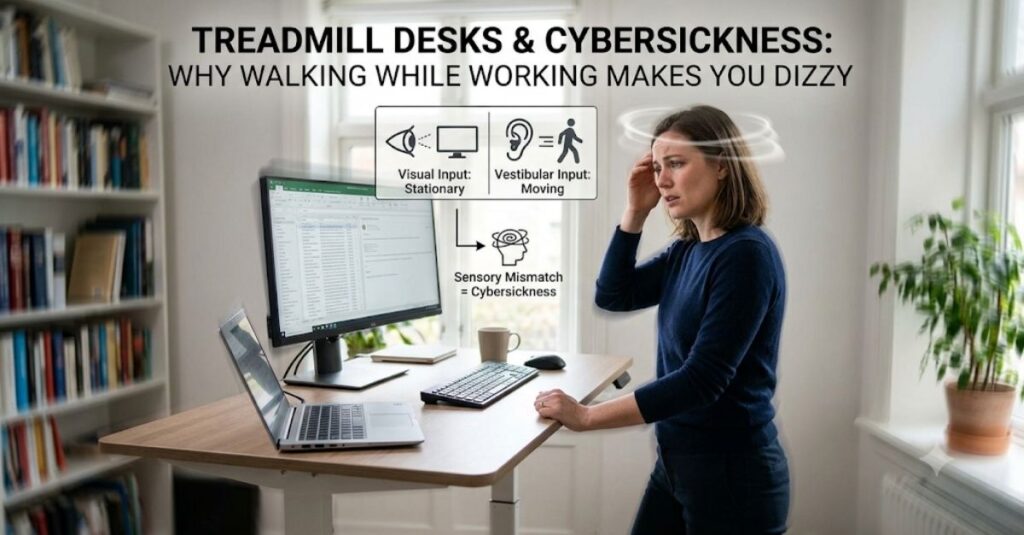
All motion sickness comes down to a sensory mismatch in your brain. Your brain relies on three primary systems to understand how your body is moving: your eyes (the visual system), your inner ear (the vestibular system), and your muscles (proprioception).
When you use a treadmill desk, you create a “perfect storm” of sensory confusion.
What Your Body Feels: Your leg muscles are firing, and your inner ear feels the rhythmic, repetitive bouncing of your stride. Your vestibular and proprioceptive systems are loudly telling your brain, “We are walking forward.”
What Your Eyes See: Your eyes are locked onto a completely static, glowing monitor positioned two feet from your face. Furthermore, because your head is bobbing slightly with each step, your eyes are forced to constantly make micro-adjustments to keep the text on the screen in focus.
Your brain panics at this aggressively conflicting data. It assumes you are hallucinating, which evolutionarily signals that you have ingested a neurotoxin. To protect you, your brain triggers a defensive nausea response to encourage you to stop moving and “expel” the toxin.
The dizziness doesn’t always stop when you turn the treadmill off. Many users experience mal de debarquement (disembarkment syndrome) when they step back onto solid ground. Because your brain just spent 30 minutes adapting to the sensation of walking while remaining in the exact same spot in the room, stopping suddenly creates a secondary sensory mismatch, leaving you feeling like you are swaying on a boat even when you are sitting in a normal chair.
You do not have to give up your active workstation. By adjusting your setup and changing how you interact with your screen, you can help your senses align.
Increase Your Font Size: The constant micro-bobbing of your head makes reading standard-sized text incredibly difficult, leading to rapid eye strain. Bump your browser zoom up to 125% or 150%. Larger text requires significantly less visual tracking, instantly reducing the strain that leads to tension headaches.
Push the Monitor Back: Do not keep your screen right in front of your nose. Push your monitor further back on your desk. This forces your eyes to take in more of your peripheral vision (the stationary walls of your office), providing a stronger visual anchor that you are not actually moving forward through space.
The 20-20-20 Rule (Walking Edition): To combat cybersickness, you must break the visual lock. Every 20 minutes, look away from your screen and focus your eyes on an object at least 20 feet away (like a picture on the far wall or out a window) for 20 seconds while you continue to walk. This resets your eye mechanics and grounds your vestibular system.
If you have adjusted your desk and still feel green after 10 minutes of walking, you need a physical intervention. However, taking over-the-counter anti-nausea medication to get through a workday is a terrible strategy, as the drowsiness and brain fog will completely destroy your productivity.
To stay alert, focused, and nausea-free, acupressure is the ultimate tool for your home office.
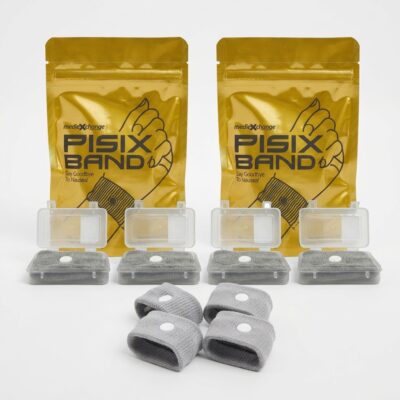
By wearing a Pisix Band while you walk, you can actively intercept the sensory mismatch. Engineered by Mediexchange, the Pisix Band features a built-in stud that applies gentle, continuous pressure to the Nei-Kuan (P6) acupressure point on your inner forearm. Stimulating this median nerve sends a grounding signal to your central nervous system that actively overrides the “dizzy” signals caused by the screen.
Zero Brain Fog: Because it is 100% chemical-free, your mind stays sharp, allowing you to breeze through your spreadsheets and Zoom calls without feeling sedated.
Comfortable for Typing: Designed to look and feel like a low-profile athletic sweatband, the stretch-fit cotton stays comfortable against your wrists while you type, never digging into your skin or interfering with your keyboard posture.
E-Commerce Ready: If you need a solution fast, the bands are packaged efficiently in a compact 16.5x10x2 cm box, optimizing them for rapid delivery. Whether you are ordering via Amazon FBA or relying on local quick-commerce apps like Blinkit right here in Indore, keeping a clear head is easier than ever.
A treadmill desk is an incredible investment in your physical health, and you shouldn’t let cybersickness sideline your goals. By optimizing your screen distance, increasing your text size, and relying on the continuous, non-drowsy relief of the Pisix Band, you can hit your step count and your deadlines without the dizziness.