You finally invest in a premium pair of Active Noise-Canceling (ANC) headphones. You put them on, flip the switch to block out the roar of your open office or a jet engine, and within minutes, something feels wrong. A dull headache creeps in, your ears feel strangely full, and a wave of nausea hits your stomach.
You haven’t moved an inch, yet you feel like you are reading in the backseat of a swerving car.
If this has happened to you, it is not in your head—it is in your ears. The phenomenon of “ANC nausea” or “cybersickness” is incredibly common. Here is the science behind why blocking out sound can accidentally trigger severe motion sickness, and how you can stop the spinning.
How “Anti-Noise” Tricks Your Brain
To understand the nausea, you have to understand how Active Noise Cancellation actually works.
Unlike traditional earplugs that simply muffle sound, ANC headphones use tiny built-in microphones to listen to the ambient noise around you (like an AC unit or an airplane engine). The headphones then instantly generate the exact opposite sound wave—called “anti-noise”—and play it through the speakers. When the ambient noise and the anti-noise collide, they cancel each other out, creating silence.
However, this technological marvel creates a massive biological misunderstanding.
The Eardrum Squeeze: The Root of the Nausea
Your brain is incredibly sensitive to low-frequency sound waves, which it often interprets as changes in air pressure.
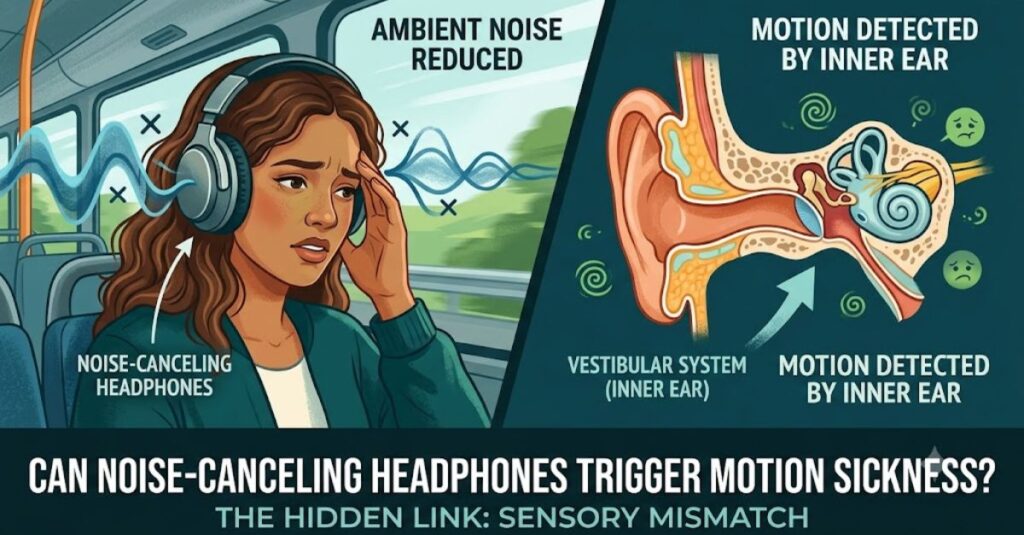
When your headphones blast low-frequency “anti-noise” into your ear canal to cancel out deep hums, your eardrums react to it. Your brain interprets this low-frequency pressure as a literal change in atmospheric pressure—the exact same sensation you feel when an airplane is taking off or when you are driving up a steep mountain.
The Sensory Mismatch
Motion sickness is always the result of a sensory conflict.
When you turn on your ANC headphones while sitting at your desk, your inner ear (the vestibular system) feels the artificial pressure change and screams to your brain: “We are rapidly changing altitude and moving fast!”
Meanwhile, your eyes are looking at a stationary computer monitor, telling your brain: “We are sitting perfectly still.”
Your brain receives this violently conflicting data, assumes you have ingested a neurotoxin that is causing hallucinations, and immediately triggers an evolutionary defense mechanism: intense nausea and a headache.
3 Ways to Stop ANC Dizziness
If your headphones are making you sick, you do not have to throw them away. You can actively manage how your brain processes the sound using these quick adjustments:
-
Lower the ANC Intensity: Many modern headphones allow you to adjust the level of noise cancellation via a companion app. Turn the ANC down to 50%. This still blocks out distracting chatter but reduces the intense low-frequency pressure that confuses your inner ear.
-
Use “Transparency” Mode: If you are feeling dizzy, switch your headphones to Transparency or Ambient mode. This allows a small amount of natural background noise to pass through, instantly relieving the artificial pressure vacuum in your ear canal and grounding your senses.
-
Play White Noise: Do not use ANC in pure silence. Playing continuous, gentle audio—like white noise, rain sounds, or lo-fi music—gives your brain a constant audio anchor, distracting it from the false pressure changes.
The Ultimate Travel Defense
For many of us, turning off the noise cancellation simply isn’t an option. If you are stuck on a 10-hour flight next to a screaming baby or a roaring engine, you need that silence to survive the trip.
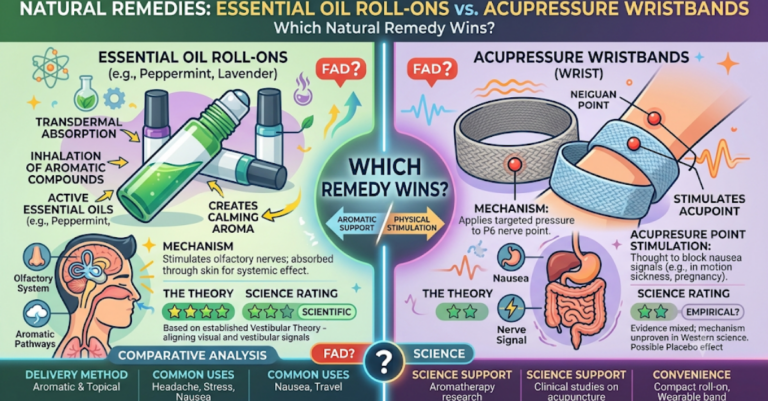
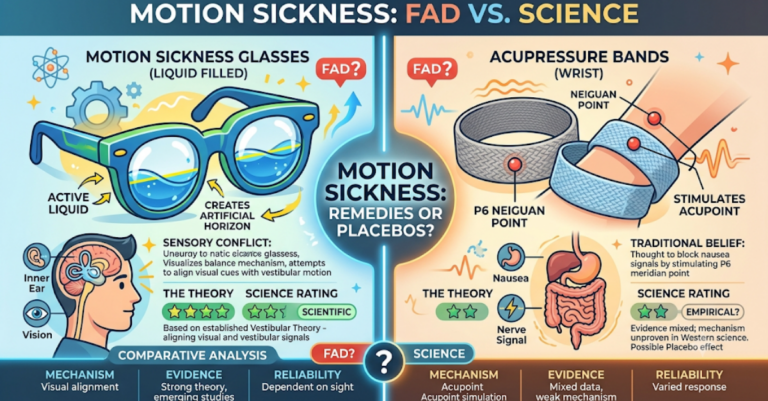
If you know you are highly sensitive to motion sickness but still need to use your ANC headphones, you have to intercept the nausea signals before they reach your stomach. The most effective, drug-free way to do this is with acupressure.
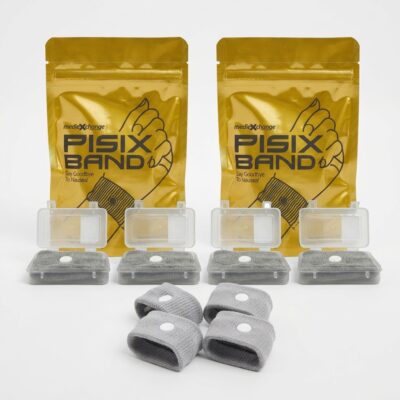
The Pisix Band allows you to safely block motion sickness without compromising your focus or resorting to drowsy medications.
Made from a soft, breathable cotton blend, it features a built-in stud that applies gentle, continuous pressure to the Nei-Kuan (P6) acupressure point on your inner forearm. Stimulating this median nerve sends a grounding signal to your central nervous system that actively overrides the “dizzy” signals caused by your headphones.
-
Clear-Headed Relief: Because it is entirely physical and chemical-free, you will not experience the heavy brain fog associated with traditional antiemetics.
-
Travel-Ready: The bands come in highly compact 16.5x10x2 cm packaging, making it effortless to slide into your laptop bag or carry-on alongside your headphones.
-
Instant Activation: You can slip the bands on the moment you power up your headphones, creating an immediate, natural defense against sensory overload.