🎉 FREE shipping + Cash on Delivery on every order · Dispatch in 24 hrs
🎉 FREE shipping + COD · Dispatch in 24 hrs
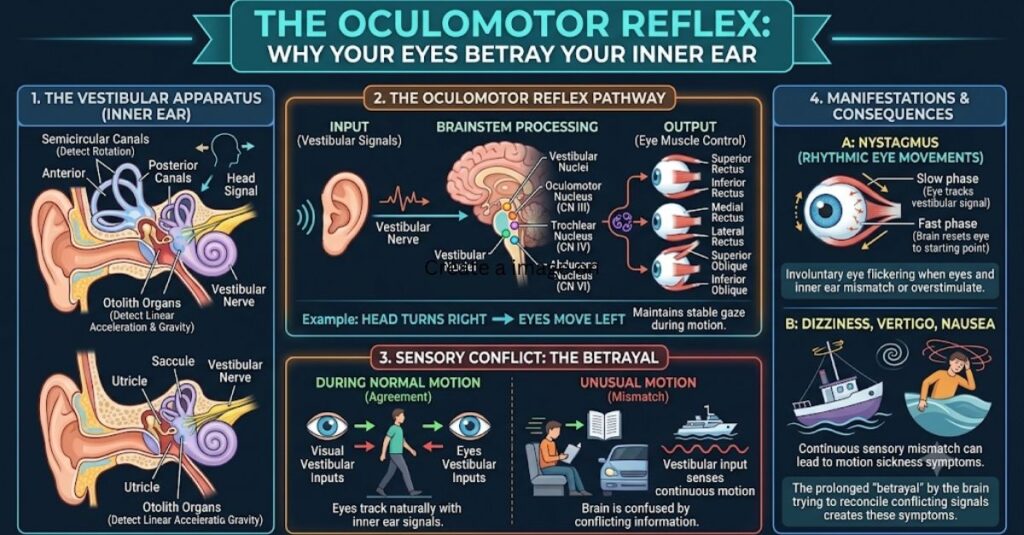
You are an hour into a road trip, sitting in the passenger seat, scrolling through your phone or reading a book. Suddenly, the words on the screen start to blur slightly. A tension headache grips your temples, and that all-too-familiar wave of nausea hits your stomach.
We all know that reading in a moving car causes motion sickness. But have you ever wondered why staring at a perfectly still page makes you dizzy?
The answer lies in an invisible tug-of-war happening inside your nervous system. It is a battle between your conscious desire to read and a deeply hardwired, unconscious biological mechanism called the vestibulo-ocular reflex (VOR).
Here is the fascinating science behind why your eyes betray your inner ear, and how you can stop the spin.
To understand the nausea, you have to understand the reflex.
The vestibulo-ocular reflex (VOR) is your brain’s built-in “steadycam.” It is a hardwired neurological pathway that connects your inner ear (the vestibular system) directly to your extraocular muscles (the muscles that move your eyes).
Its sole purpose is to stabilize your vision when your head moves. If you turn your head to the left, your inner ear detects the movement and instantly fires a signal to your eye muscles, telling them to dart to the right at the exact same speed. This reflex happens completely unconsciously, allowing you to keep your gaze locked on a target even while running or jumping.
Under normal circumstances, the VOR is flawless. But when you get into a car and try to read a book, you create a massive biological glitch.
As the car hits a bump or takes a turn, your body moves. The fluid inside your inner ear sloshes around, detecting the motion. Following its biological programming, the inner ear instantly fires the VOR, commanding your eye muscles to move in the opposite direction to compensate for the bump.
However, your conscious brain is trying to keep your eyes locked on the static text of your book or phone screen.
To keep reading, your eyes have to actively, consciously fight against the unconscious tug of the VOR. Every single time the car vibrates, hits a pothole, or accelerates, your eye muscles are pushed and pulled in conflicting directions. This rapid, microscopic battle completely exhausts your visual system in minutes, leading to severe eye strain, tension headaches, and the classic “sensory mismatch” that triggers the brain’s vomiting center.
The VOR isn’t the only reflex that causes trouble. If you give up on your book and look out the side window at the passing trees, you trigger a different reflex: optokinetic nystagmus.
This is an involuntary eye twitch. As a tree flashes by at 60 mph, your eyes automatically lock onto it, track it backward, and then aggressively snap forward to catch the next tree. This rapid, repetitive darting further strains your extraocular muscles and confuses the brain, accelerating the dizziness.
You can immediately stop the biological tug-of-war by giving your reflexes what they want: a stable, distant target.
Look at the Horizon: Put the book down and look straight out the front windshield at the furthest point on the horizon (like a distant mountain or cloud).
Why it works: Distant objects appear to move very slowly, preventing the rapid optokinetic flicker. More importantly, when you look out the front window, your eyes can actually see the turns and bumps coming. This allows your visual system to send data to your brain that perfectly matches the motion your inner ear is feeling, instantly calming the VOR and stopping the sensory panic.
If you have to work, read, or navigate during a car ride, staring at the horizon isn’t an option. But taking traditional antihistamine motion sickness pills to survive the trip will leave you heavily sedated and battling brain fog.
To stay alert, productive, and nausea-free, you need to intercept the distress signals without flooding your brain with chemicals. The most effective way to do this is with acupressure.
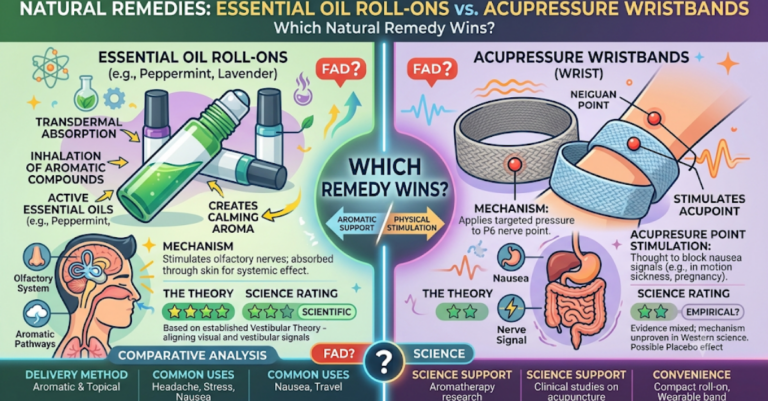
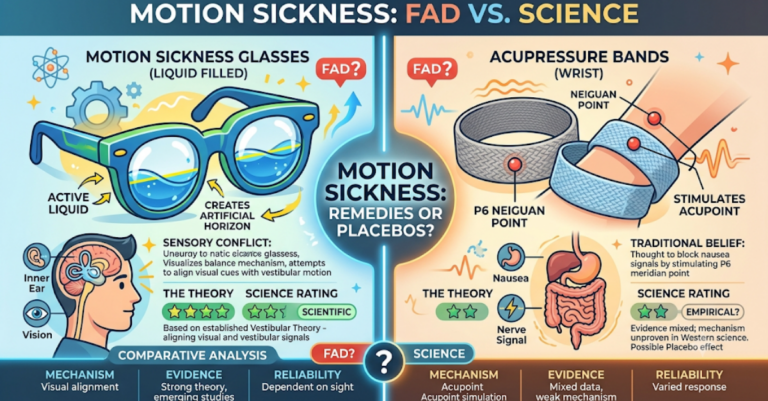
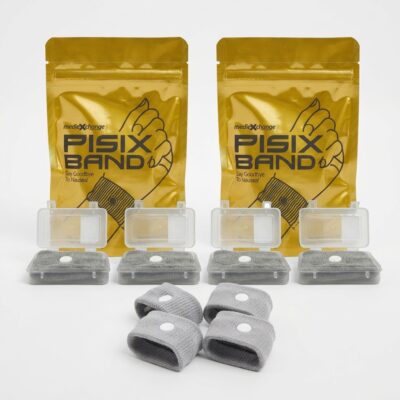
By wearing a Pisix Band, you can safely hit the override switch on your nervous system. Engineered by Mediexchange, the Pisix Band is a stretch-fit cotton wristband with a built-in precision stud. This stud applies continuous, gentle pressure to the Nei-Kuan (P6) acupressure point on your inner forearm.
Stimulating this median nerve sends a powerful, grounding signal directly to your central nervous system that actively blocks the nausea signals caused by your overworked eye muscles.
Zero Drowsiness: Because it is entirely physical, you retain your sharp focus—meaning you can finish that book or clear out your inbox without feeling groggy.
Comfortable & Discreet: The low-profile design looks like a simple athletic band and won’t dig into your wrists while you type or hold your phone.
Highly Accessible: Designed for rapid logistics, the bands are packaged efficiently in a compact 16.5x10x2 cm box. Whether you are stocking up for a family road trip nationally via Amazon FBA or grabbing a pair locally through 10-minute quick-commerce apps like Blinkit right here in Indore, keeping a clear head has never been easier.
Getting sick while reading in the car isn’t a sign of a weak stomach; it is a sign that your neurological reflexes are working exactly as they were designed to. By understanding how the vestibulo-ocular reflex operates, taking strategic screen breaks to look at the horizon, and relying on the non-drowsy relief of the Pisix Band, you can stop fighting your own eyes and enjoy the ride.