🎉 FREE shipping + Cash on Delivery on every order · Dispatch in 24 hrs
🎉 FREE shipping + COD · Dispatch in 24 hrs
You are sitting in the backseat of a car winding through steep mountain roads, or perhaps you are on a boat hitting heavy chop. Suddenly, a cold sweat breaks out on your forehead, you start yawning uncontrollably, and your stomach completely drops.
When motion sickness hits, it feels like a digestive problem. But your stomach is actually just the victim. The true culprit behind your nausea is located directly behind your eardrum, in a tiny, fluid-filled maze.
If you want to understand why a bumpy ride makes you green—and more importantly, how to stop it—you need to understand endolymphatic fluid. Here is the fascinating biology of what is sloshing around inside your head during a turbulent trip.
To maintain your balance, your brain relies heavily on the vestibular system, a complex structure located deep inside your inner ear.
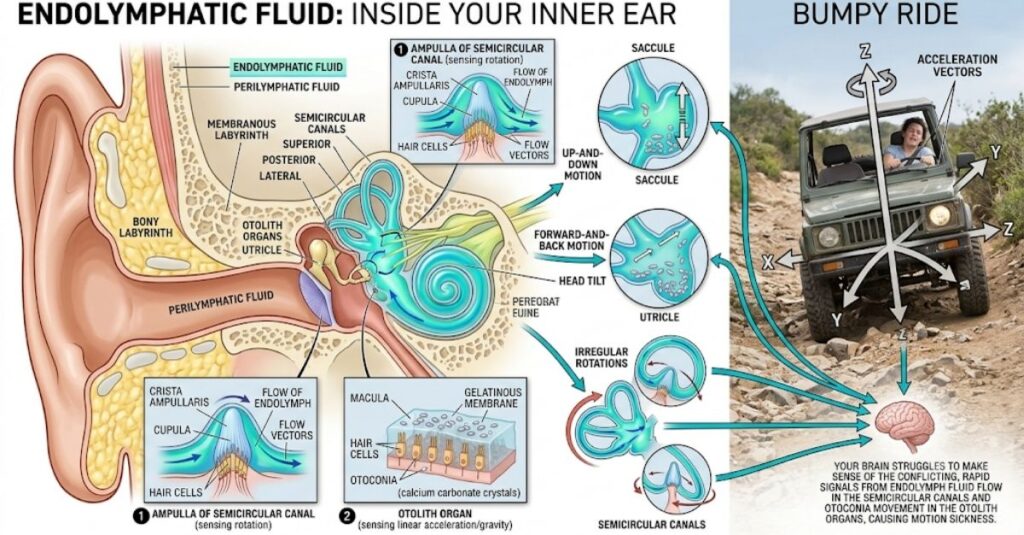
The most critical part of this system is the semicircular canals—three tiny, looping tubes arranged at right angles to one another (representing up/down, left/right, and side-to-side motion).
These canals are completely hollow, except for two very important components:
Hair Cells (Cilia): Microscopic sensory sensors that line the inside of the canals.
Endolymphatic Fluid (Endolymph): A thick, jelly-like, potassium-rich fluid that fills the canals.
When you are walking down the street and you turn your head to the left, your skull moves instantly. However, because the endolymphatic fluid is thick and heavy, it has a slight delay—it “sloshes” against the movement, much like water inside a glass when you suddenly slide it across a table.
As the fluid sloshes, it physically bends the microscopic hair cells (cilia). When these hair cells bend, they fire off an electrical signal through the vestibular nerve straight to your brain, translating exactly how fast and in what direction your head just moved.
Under normal, self-propelled circumstances (like walking or running), this system is flawless.
The system breaks down when you enter a vehicle. The human inner ear evolved over millions of years to track the speed of human walking or running—it was never designed to process the aggressive, multi-directional forces of a car doing 60 mph on a winding road.
During a bumpy ride, your body is subjected to rapid acceleration, hard braking, and aggressive lateral sway.
Inside your inner ear, the endolymphatic fluid is violently sloshing back and forth, crashing into the hair cells from every possible direction. The cilia are firing off thousands of frantic, chaotic electrical signals per minute. Your brain is receiving a message that your head is spinning, dropping, and accelerating all at once.
The fluid chaos wouldn’t be a massive problem if your eyes agreed with it. But if you are staring at a phone screen or reading a book in the backseat, your eyes are locked onto a stationary object.
Your eyes tell your brain: “We are sitting perfectly still.”
Your endolymphatic fluid screams: “We are tumbling out of control!”
Your brain cannot reconcile this aggressive contradiction. It assumes you are hallucinating due to neurotoxin poisoning and triggers the autonomic nervous system to “expel the toxin”—resulting in cold sweats and a churning stomach.
You cannot stop the car from hitting bumps, but you can manage how your inner ear reacts to them.
Look at the Horizon: Give your brain a massive visual anchor. By staring out the front windshield at the distant horizon, your eyes can actually see the turns and bumps coming, allowing them to send matching data to your brain that aligns with the sloshing fluid.
Stay Hydrated: Endolymphatic fluid relies on a delicate balance of water and electrolytes (specifically potassium). If you are dehydrated, the viscosity (thickness) of the fluid changes, making the hair cells hyper-sensitive to every tiny bump in the road.
If you are highly susceptible to motion sickness, managing your visual focus might not be enough to stop the nausea once the fluid starts sloshing. But taking traditional antihistamine motion sickness pills will leave you heavily sedated with brain fog.
To stay alert and nausea-free, you need to intercept the panic signal after it leaves the inner ear but before it reaches the stomach. The most effective, drug-free way to do this is with acupressure.
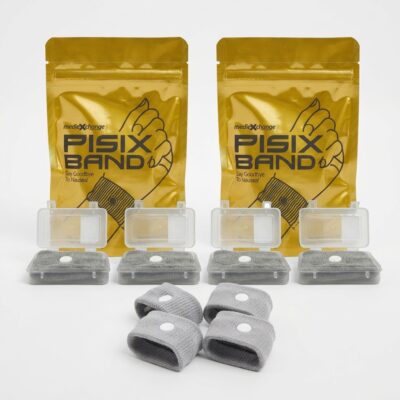
By wearing a Pisix Band, you can safely hit the override switch on your nervous system. Brought to you by Mediexchange, the Pisix Band is a stretch-fit cotton wristband with a built-in precision stud. This stud applies continuous, gentle pressure to the Nei-Kuan (P6) acupressure point on your inner forearm.
Stimulating this median nerve sends a powerful, grounding signal directly to your central nervous system that actively blocks the distress signals caused by your chaotic inner ear fluid.
Zero Drowsiness: Because it is entirely physical, you retain your sharp focus and energy for the entire trip.
Highly Accessible: Designed for modern e-commerce, the bands are packaged efficiently in a compact 16.5x10x2 cm box. Whether you are ordering nationally via Amazon FBA or grabbing them locally through 10-minute quick-commerce apps like Blinkit right here in Indore, you can get reliable relief delivered exactly when you need it.
Your inner ear is a marvel of biological engineering, but it wasn’t built for winding mountain roads. By understanding how endolymphatic fluid tracks motion, keeping your eyes on the horizon, and utilizing the continuous, non-drowsy relief of the Pisix Band, you can quiet the sensory chaos and enjoy the ride.